>
Cypriniformes (Carps) >
Cyprinidae (Minnows or carps) > Barbinae
Etymology: Barbus: Latin, barbus = barbel (Ref. 45335).
Eponymy: Sir Charles Alfred Payton (1843–1926) was a British adventurer, writer, fisherman and diplomat who was British Consul to Morocco, where this barb is found. [...] (Ref. 128868), visit book page.
Ambiente: milieu / zona climatica / distribuzione batimetrica / gamma di distribuzione
Ecologia
; acqua dolce benthopelagico. Temperate
Europe: Tisza system (Danube drainage), from Hron to Someş sub-systems, occasionally reaching to eastern Austria; upper Vistula drainage in Slovakia and Poland; Wierzyca system (lower Vistula drainage, Poland); upper Dniestr drainage in Poland and Ukraine.
Lunghezza alla prima maturità / Dimensione / Peso / Età
Maturità: Lm 12.5, range 11 - 14 cm
Max length : 27.0 cm SL maschio/sesso non determinato; (Ref. 59043)
Breve descrizione
Chiavi di identificazione | Morfologia | Morfometria
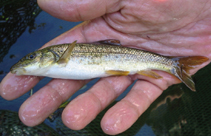
Differs from its congeners in Danube drainage and northern central Europe by having the following characters: last simple dorsal ray weak, not serrated posteriorly, segmented on its entire length; lower lip thick, with a median lobe; 8-11 scale rows between lateral line and dorsal origin; 8-9 rows of scales between lateral line and pelvic origin; top of head plain; cheek and opercle unspotted or with very few small spots; paired fins unspotted, rays unpigmented or with few dark pigments not forming dark bars; body plain with faint dots and blotches slightly darker than background; caudal fin unspotted or with spots smaller than pupil diameter. However, these characters may be of little use when differentiating this species from Barbus balcanicus and Barbus petenyi in the field as identification of Barbus carpathicus is based mainly on mtDNA characters (Ref. 59043).
Body shape (shape guide): elongated.
Inhabits fast to moderate flowing premontane and montane streams and small rivers with gravel bottom. Most abundantly found in shallow rapids and riffles during summer and moves to deeper places in winter. Larvae and juveniles live on the bottom in very shallow shoreline habitats and leave the shores for faster-flowing waters as they grow. Feeds on a wide variety of benthic vertebrates and algae. Spawns in fast-flowing water (0.8-1 m/s) of shallow riffles with depth 0.5-0.8 m (Ref. 59043).
Ciclo vitale e comportamento di accoppiamento
Maturità | Riproduzione | Deposizione | Uova | Fecondità | Larve
Kottelat, M. and J. Freyhof, 2007. Handbook of European freshwater fishes. Publications Kottelat, Cornol and Freyhof, Berlin. 646 pp. (Ref. 59043)
Stato della Lista Rossa IUCN (Ref. 130435: Version 2025-2 (Global))
Minaccia per l'uomo
Harmless
Usi umani
Pesca: di nessun interesse
Strumenti
Rapporti speciali
Scarica XML
Fonti Internet
Stime basate su modelli
Indice di diversità filogenetica (Fonte Biblio.
82804): PD
50 = 0.5000 [Uniqueness, from 0.5 = low to 2.0 = high].
Bayesian length-weight: a=0.00832 (0.00536 - 0.01290), b=3.05 (2.92 - 3.18), in cm total length, based on LWR estimates for this species & Genus-body shape (Ref.
93245).
Livello trofico (Fonte Biblio.
69278): 3.1 ±0.4 se; based on size and trophs of closest relatives
Resilienza (Fonte Biblio.
120179): Medio, tempo minimo di raddoppiamento della popolazione 1.4 - 4.4 anni (Preliminary K or Fecundity.).
Vulnerabilità della pesca (Ref.
59153): Low vulnerability (23 of 100).
🛈