分類 / 名前
共通名の | 類義語 | Catalog of Fishes(部類, 種) | ITIS | CoL | WoRMS | Cloffa
>
Gobiiformes (Gobies) >
Gobiidae (Gobies) > Sicydiinae
Etymology: Stiphodon: Greek, stiphos, -eos, -oys = mass + Greek, odous = teeth (Ref. 45335).
環境:環境 / 気候帯 / 深さの範囲 / 分布範囲
生態学
海; 新鮮な水; 汽水性の 底生の漂泳性; 両側回遊性. Subtropical
Asia: Hainan Island and the mainland of South China (probably endemic to China). Also from Japan (Ref. 93128).
サイズ / 重さ / 年齢
成熟: Lm ? range ? - ? cm
Max length : 8.0 cm SL オス/雌雄の選別がない; (Ref. 82695)
簡単な記述
検索表 | 形態学 | 形態計測学
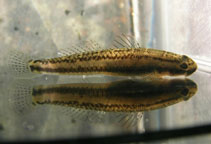
背面の脊椎 (合計) : 7; 背鰭 (合計) : 9; 肛門の骨: 1; 臀鰭: 10. This species is a large-sized Stiphodon with the pectoral fin spotted and sexual dimorphism obvious. Mature male has the upper one-third of the body khaki and lower part silvery grey/ grayish brown (some individuals would be darker in colour) with 9-10 lateral bars, first dorsal fin elongated, triangular and sometimes filamentous, predorsal midline without scales or with very few scales (certain individuals would have some scales); while the female has creamy with two obvious transverse stripes on the body, sometimes with several dull lateral bars, dorsum with several gold bars, ventrum light blue.
Body shape (shape guide): elongated.
Adults inhabit clear streams and mainly feed on epiphyte and biofilm on rocks in the wild. Due to its possible amphidromous nature, as known to occur with its congeners (adults live and breed in freshwater streams; larvae hatched drift downstream and develop in marine environments; juveniles return to freshwater streams), blockage of the migration pathway (e.g. construction of dam or culvert in streams) would cause a significant impact on this species. Ensuring no net loss of habitat, keeping the natural stream flow and maintaining the stream-ocean corridor are all essential for preserving this species (based on researches on its congeners; see Ref. 82683, 82684, 82685, 82689, 82690, 82692). Collection conducted by aquarium hobbyists (both private and commercial) also poses a serious threat to Stiphodon species in some regions (Ref. 82684) and this kind of activity should be strictly controlled (Ref. 82694).
ライフサイクルと交尾行動
成熟 | 繁殖 | 放精 | 卵 | 生産力 | 幼生
Zhu, S.-Q., 1995. Synopsis of freshwater fishes of China. Jiangsu Science and Technology Publishing House i-v + 1-549. (Ref. 45679)
IUCNのレッドリストの状況は (Ref. 130435: Version 2025-2 (Global))
人間の用途
水産業: 興味がない
用具
特記事項
XMLをダウンロードして下さい
インターネットの情報源
モデルに基づく推定値
系統多様性指数 (参照
82804): PD
50 = 0.5000 [Uniqueness, from 0.5 = low to 2.0 = high].
Bayesian length-weight: a=0.00389 (0.00180 - 0.00842), b=3.12 (2.94 - 3.30), in cm total length, based on all LWR estimates for this body shape (Ref.
93245).
回復力 (参照
120179): 高い, 15か月以下の倍増期間の最小個体群 (Preliminary K or Fecundity.).
漁業の脆弱性 (Ref.
59153): Low vulnerability (10 of 100).
🛈