>
Polypteriformes (Bichirs) >
Polypteridae (Bichirs)
Etymology: Polypterus: Greek, poly = a lot of + Greek, pteron = wing, fin (Ref. 45335); teugelsi: Named after Guy Teugels, curator of fishes at the Royal Museum for Central Africa (MRAC), in honor of his myriad influential contributions to the systematics of African freshwater fishes (Ref. 51884).
Eponymy: Dr Guy G Teugels (1954–2003) was a Belgian ichthyologist. [...] (Ref. 128868), visit book page.
Ambiente: milieu / zona climatica / distribuzione batimetrica / gamma di distribuzione
Ecologia
; acqua dolce demersale; pH range: 7.4 - 7.5; dH range: ? - 1. Tropical; 25°C - 27°C (Ref. 51884)
Africa: restricted to upper Cross River in Cameroon (Ref. 51884, 81628).
Dimensione / Peso / Età
Maturità: Lm ? range ? - ? cm
Max length : 41.5 cm SL maschio/sesso non determinato; (Ref. 51884)
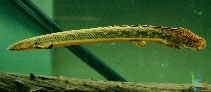
Spine dorsali (totale) : 7 - 9; Vertebre: 63 - 65. Diagnosis: Polypterus teugelsi is distinguished from all congeners by its unique live colouration comprising a network of black marks on an olive background on the dorsal and dorsolateral surface of the body, black pectoral fins, and an orange belly (Ref. 51884). It is further distinguished from species of the Polypterus bichir group by having the dorsal spines not extending anteriorly to the vertical through the posterior margin of the pectoral fin vs. extending to that point, 28-33 predorsal scales vs. 11-16, 7-9 dorsal spines vs. 11-18, and 37-40 scales around the body vs. 42-52 (Ref. 51884). It differs from all remaining Polypterus species, except P. ornatipinnis, by having more scales in the lateral line, 63-65 vs. 51-61 (Ref. 51884). It is distinguished from P. ornatipinnis in having 7-9 dorsal spines vs. 9-11, 28-33 predorsal scales vs. 22-27, 37-40 scales around the body vs. 40-42, and a very different colour pattern (Ref. 51884). It is distinguished from the similar Polypterus retropinnis in having a longer predorsal portion of the body, the predorsal length 46,7-54,8% of standard length vs. 55,7-63,2% and distance between pectoral fin and dorsal fin 18,3-25,2% of standard length vs. 30,2-42,6%; more prepelvic scales, 48-51 vs. 44-46; fewer predorsal scales, 28-33 vs. 33-36; more pectoral-fin rays, 40-42 vs. 26-32; more vertebrae, 63-65 vs. 57-58; in the absence of the distinct black blotch on the pectoral fin base vs. presence; and in the clour pattern of the dorsal and dorsolateral portions of the body, irregular dark marks forming a network vs. large dorsal black blotches (Ref. 51884).
Body shape (shape guide): elongated.
Facultative air-breathing in the genus (Ref. 126274); Most abundant in densely shaded rainforest streams (Ref. 51884).
Ciclo vitale e comportamento di accoppiamento
Maturità | Riproduzione | Deposizione | Uova | Fecondità | Larve
Britz, R., 2004. Polypterus teugelsi, a new species of bichir from the Upper Cross River system in Cameroon (Actinopterygii: Cladistia: Polypteridae). Ichthyol. Explor. Freshwat. 15(2):179-186. (Ref. 51884)
Stato della Lista Rossa IUCN (Ref. 130435: Version 2025-2 (Global))
Minaccia per l'uomo
Harmless
Usi umani
Strumenti
Rapporti speciali
Scarica XML
Fonti Internet
Stime basate su modelli
Indice di diversità filogenetica (Fonte Biblio.
82804): PD
50 = 0.5003 [Uniqueness, from 0.5 = low to 2.0 = high].
Bayesian length-weight: a=0.00457 (0.00194 - 0.01077), b=3.05 (2.85 - 3.25), in cm total length, based on LWR estimates for this (Sub)family-body shape (Ref.
93245).
Livello trofico (Fonte Biblio.
69278): 3.3 ±0.5 se; based on size and trophs of closest relatives
Resilienza (Fonte Biblio.
120179): Alto, tempo minimo di raddoppiamento della popolazione meno di 15 mesi (Preliminary K or Fecundity.).
Vulnerabilità della pesca (Ref.
59153): Moderate vulnerability (40 of 100).
🛈