>
Cypriniformes (Carps) >
Nemacheilidae (Brook loaches)
Etymology: Schistura: Greek, schizein = to divide + Greek, oura = tail; an allusion to forked caudal fins (Ref. 45335); oedipus: Specific epithet means a mythic Theban King who tore out his eyes (Ref. 39226).
Eponymy: This is not a true eponym as Oedipus was a mythical Theban king who tore out his eyes (after discovering that the woman he married was his own mother). The binomial is here used in fanciful reference to the loach’s degenerate eyes. (Ref. 128868), visit book page.
More on author: Kottelat.
Environnement : milieu / zone climatique / profondeur / gamme de distribution
Écologie
; eau douce benthopélagique; profondeur 0 - ? m (Ref. 42927). Tropical; 20°N - 19°N
Asia: Thailand.
Taille / Poids / Âge
Maturité: Lm ? range ? - ? cm
Max length : 5.4 cm SL mâle / non sexé; (Ref. 39226)
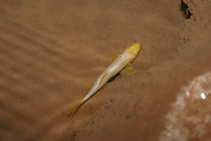
Rayons mous dorsaux (Total) : 12; Rayons mous anaux: 8. No color pattern; absence of externally visible eye but a pit in the center of the skin covering the orbit (Ref. 39226). Retains some melanin pigmentation (Ref. 42927).
Body shape (shape guide): elongated.
Cave-restricted species (Ref. 12041). Collected in a pool of moving water about 1 km from a cave entrance (Ref. 39226). Mostly found stationary on the muddy bottom at depths from 20 cm to 1 m (Ref. 42927). Tends to occur in slow moving water during the dry season, but some individuals were observed climbing rapids (Ref. 42927). Small groups of individuals were frequently found in the pools while isolated individuals were common in rapids (Ref. 42927). Weakly or not at all cryptobiotic, not remaining under rocks for more than 5 min during the day (Ref. 42927). Feeds on insects and roundworms (Ref. 42927). Shows behavioral responses to light, including avoidance and perhaps a residual diurnal rhythmicity (Ref. 42927).
Cycle de vie et comportement reproducteur
Maturité | Reproduction | Frai | Œufs | Fécondité | Larves
Kottelat, M., 1990. Indochinese nemacheilines. A revision of nemacheiline loaches (Pisces: Cypriniformes) of Thailand, Burma, Laos, Cambodia and southern Viet Nam. Verlag Dr. Friedrich Pfeil, München, Germany. 262 p. (Ref. 39226)
Statut dans la liste rouge de l'IUCN (Ref. 130435: Version 2025-2 (Global))
Menace pour l'homme
Harmless
Utilisations par l'homme
Pêcheries: sans intérêt
Outils
Articles particuliers
Télécharger en XML
Sources Internet
Estimations basées sur des modèles
Indice de diversité phylogénétique (Réf.
82804): PD
50 = 0.5000 [Uniqueness, from 0.5 = low to 2.0 = high].
Bayesian length-weight: a=0.00708 (0.00323 - 0.01553), b=3.03 (2.86 - 3.20), in cm total length, based on LWR estimates for this Genus-body shape (Ref.
93245).
Niveau trophique (Réf.
69278): 3.1 ±0.34 se; based on food items.
Résilience (Réf.
120179): Haut, temps minimum de doublement de population inférieur à 15 mois (Preliminary K or Fecundity.).
Vulnérabilité de la pêche (Ref.
59153): Low vulnerability (10 of 100).
🛈