Klassifizierung / Names
Namen | Synonyme | Catalog of Fishes(Gattung, Arten) | ITIS | CoL | WoRMS | Cloffa
>
Siluriformes (Catfishes) >
Bagridae (Bagrid catfishes)
Etymology: Mystus: Greek, mystax = whiskered, used by Belon in 1553 to describe all fishes with whiskers (Ref. 45335); impluviatus: From the Latin impluvium, referring to a skylight, in allusion to the second posterior fontanel on the supraoccipital of this species.
Umwelt: Milieu / Klimazone / Tiefenbereich / Verbreitungsgebiet
Ökologie
; süßwasser demersal. Tropical
Asia: Indonesia.
Größe / Gewicht / Alter
Geschlechtsreife: Lm ? range ? - ? cm
Max length : 12.0 cm SL Männchen/unbestimmt; (Ref. 51149)
Kurzbeschreibung
Bestimmungsschlüssel | Morphologie | Morphometrie
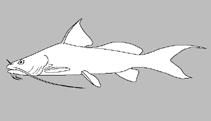
Rückenflossenweichstrahlen (insgesamt) : 6 - 7; Afterflossenweichstrahlen: 11 - 13; Wirbelzahl: 37 - 39. Differs from both Mystus castaneus and Mystus nigriceps in having a second posterior fontanel on the supraoccipital. It further differs from Mystus castaneus in having a shallower adipose fin (4.7-6.0% SL vs. 6.1-7.0), smaller serrations on the posterior edge of the pectoral spine (maximum height of serrations 3.6-4.8% of spine length vs 6.9-8.0) and a more deeply forked caudal fin with a more slender upper lobe. Further differs from Mystus nigriceps in having a longer adipose fin base (31.6-36.1% SL vs 26.3-31.4), longer second and third dorsal fin rays, causing the dorsal fin to appear less rounded, and a brown body with a distinct darl triangular patch on the base of the caudal peduncle (vs. greenish gray body with a diffuse dark triangular patch on the base of the caudal peduncle).
Body shape (shape guide): elongated.
Facultative air-breathing in the genus (Ref. 126274); Oviparous, distinct pairing possibly like other members of the same family (Ref. 205).
Lebenszyklus und Paarungsverhalten
Geschlechtsreife | Fortpflanzung | Ablaichen | Eier | Fruchtbarkeit | Larven
Ng, H.H., 2003. Mystus impluviatus: a new species of bagrid catfish (Teleostei: Bagridae) from Eastern Borneo. Copeia 2003(2):373-378. (Ref. 51149)
IUCN Rote Liste Status (Ref. 130435: Version 2025-2 (Global))
Bedrohung für Menschen
Harmless
Nutzung durch Menschen
Tools
Zusatzinformationen
Download XML
Internet Quellen
Schätzungen auf der Grundlage von Modellen
Phylogenetischer Diversitätsindex (Ref.
82804): PD
50 = 0.5000 [Uniqueness, from 0.5 = low to 2.0 = high].
Bayesian length-weight: a=0.00813 (0.00354 - 0.01865), b=2.94 (2.77 - 3.11), in cm total length, based on LWR estimates for this Genus-body shape (Ref.
93245).
Trophische Ebene (Ref.
69278): 3.3 ±0.4 se; based on size and trophs of closest relatives
Widerstandsfähigkeit (Ref.
120179): mittel, Verdopplung der Population dauert 1,4 - 4,4 Jahre. (Assuming Fec < 10,000).
Anfälligkeit der Fischerei (Ref.
59153): Low vulnerability (10 of 100).
🛈