Clasificación / Nombres
Nombres comunes | Sinónimos | Catalog of Fishes(Género, Especie) | ITIS | CoL | WoRMS | Cloffa
>
Siluriformes (Catfishes) >
Ailiidae (Asian schilbeids)
Etymology: Clupisoma: Latin, clupea = sardine, derived from Clupeus = shield; doubtless a reference to the sacles covering the body of the fish + Greek, soma = body (Ref. 45335); roosae: The species is named for Anna Roos who, together with Fang Fang, both of the Swedish Museum of Natural History, collected the holotype of this species.
Eponymy: Dr Anna Roos (d: 1961) is an ecotoxicologist, researcher and curator at Department of Environmental Research and Monitoring, Swedish Museum of Natural History (1988– present), and at the Climate Centre, Greenland Institute of Natural Resources (2016 [...] (Ref. 128868), visit book page.
Entorno: milieu / zona climática / rango de profundidad / gama de distribución
Ecología
; agua dulce bentopelágico. Subtropical
South East Asia: Myanmar: upper reaches of Irrawaddy River, from Myitkyina northwards.
Tamaño / Peso / Edad
Madurez: Lm ? range ? - ? cm
Max length : 15.4 cm SL macho / no sexado; (Ref. 51091)
Descripción breve
Claves de identificación | Morfología | Morfometría
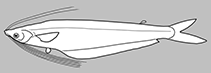
Espinas dorsales (total) : 2; Radios blandos dorsales (total) : 7; Espinas anales: 0; Radios blandos anales: 47 - 55; Vértebra: 45 - 47. A species of Clupisoma in which the pectoral spine does not reach past the base of the pelvic fin, the abdomen is keeled only from a vertical through the pelvic-fin origin to the anus, pectoral fin with a spine and 11 segmented rays, anal fin with 4 or 5 unbranched, and 43-50 branched rays, and first gill arch with fewer than 18 rakers on the outer face. The body is silvery or white below the lateral line posterior of the pectoral fin, and steel gray above; more anteriorly, the grayish region extends to level of the pectoral-fin origin. D. II, 7; A. iv-v, 43-50; Pt. I, 11; Pv. i, 5. Four pairs of barbels: one pair of nasal barbels, one pair of maxillary barbels; two pair of mental barbels, and one pair of outer mental barbels.
Body shape (shape guide): elongated; Cross section: compressed.
Oviparous, eggs are unguarded (Ref. 205).
Ciclo vital y comportamiento de apareamiento
Madurez | Reproducción | Puesta | Huevos | Fecundidad | Larva
Distinct pairing (Ref. 205).
Ferraris, C.J. Jr., 2004. A new species of the Asian schilbid catfish genus Clupisoma from Myanmar, with a redescription of Clupisoma prateri Hora (Osteichthyes: Siluriformes: Schilbidae). Zootaxa 437:1-10. (Ref. 51091)
Situación en la Lista Roja de la UICN (Ref. 130435: Version 2025-2 (Global))
Amenaza para el ser humano
Harmless
Usos humanos
Herramientas
Informes especiales
Descargar XML
Fuentes de Internet
Estimaciones basadas en modelos
Índice de diversidad filogenética (Referencia
82804): PD
50 = 0.5010 [Uniqueness, from 0.5 = low to 2.0 = high].
Bayesian length-weight: a=0.00537 (0.00245 - 0.01178), b=3.06 (2.87 - 3.25), in cm total length, based on LWR estimates for this (Sub)family-body shape (Ref.
93245).
Nivel trófico (Referencia
69278): 3.5 ±0.6 se; based on size and trophs of closest relatives
Resiliencia (Referencia
120179): Alto, población duplicada en un tiempo mínimo inferior a 15 meses (Preliminary K or Fecundity.).
Vulnerabilidad pesquera (Ref.
59153): Low vulnerability (10 of 100).
🛈