Klassifizierung / Names
Namen | Synonyme | Catalog of Fishes(Gattung, Arten) | ITIS | CoL | WoRMS | Cloffa
Umwelt: Milieu / Klimazone / Tiefenbereich / Verbreitungsgebiet
Ökologie
; süßwasser benthopelagisch. Tropical
Africa: residual pools of seasonal rivers of White Nile River basin in central Sudan and south-west Ethiopia (Ref. 82677).
Größe / Gewicht / Alter
Geschlechtsreife: Lm ? range ? - ? cm
Max length : 5.0 cm SL Männchen/unbestimmt; (Ref. 82677)
Kurzbeschreibung
Bestimmungsschlüssel | Morphologie | Morphometrie
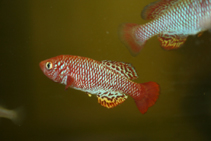
Rückenflossenstacheln (insgesamt) : 0; Rückenflossenweichstrahlen (insgesamt) : 17 - 19; Afterflossenstacheln: 0; Afterflossenweichstrahlen: 17 - 19. Diagnosis: Nothobranchius nubaensis can be distinguished from all other species of the genus by the following combination of characters: 17-19 dorsal fin rays; 17-19 anal fin rays; 29-30 scales in median lateral series; dorsal and anal fin with short filamentous rays in males; pelvic fins short, tips reaching the anus; orange-red head with 3 distinct oblique bars on the operculum; dorsal fin light blue with a pattern of irregular orange-red spots and elongated yellow spots in distal areas; anal fin yellow, light blue at base, with a pattern of orange-red spots; pelvic fins yellow with a pattern of orange-red spots; pectoral fins orange-red with a light blue margin; caudal fin orange-red, with short pale or dark red lines extending from fin base onto fin rays (Ref.82677).
Body shape (shape guide): fusiform / normal.
Found in residual pools of seasonal rivers and rainwater filled depressions (Ref. 82677). The present disjunct distribution pattern of Nothobranchius nubaensis can be explained by the dynamics of the changing rain pattern and climatic conditions over the vast plains of central and southern Sudan and south-west Ethiopia (Ref. 82677).
Lebenszyklus und Paarungsverhalten
Geschlechtsreife | Fortpflanzung | Ablaichen | Eier | Fruchtbarkeit | Larven
Valdesalici, S., M. Bellemans, K. Kardashev and A. Golubtsov, 2009. Nothobranchius nubaensis (Cyprinodontiformes: Nothobranchiidae) a new annual killifish from Sudan and Ethiopia. aqua, Int. J. Ichthyol. 15(3): 143-152. (Ref. 82677)
IUCN Rote Liste Status (Ref. 130435: Version 2025-2 (Global))
Bedrohung für Menschen
Harmless
Nutzung durch Menschen
Tools
Zusatzinformationen
Download XML
Internet Quellen
Schätzungen auf der Grundlage von Modellen
Phylogenetischer Diversitätsindex (Ref.
82804): PD
50 = 0.5000 [Uniqueness, from 0.5 = low to 2.0 = high].
Bayesian length-weight: a=0.00603 (0.00250 - 0.01453), b=3.13 (2.93 - 3.33), in cm total length, based on LWR estimates for this (Sub)family-body shape (Ref.
93245).
Trophische Ebene (Ref.
69278): 3.2 ±0.4 se; based on size and trophs of closest relatives
Anfälligkeit der Fischerei (Ref.
59153): Low vulnerability (10 of 100).
🛈