Elasmobranchii (haaien en roggen) (sharks and rays) >
Myliobatiformes (Stingrays) >
Urolophidae (Round rays)
Etymology: Urolophus: Greek, oura = tail + Greek, lophos = crest (Ref. 45335); deforgesi: Named for Bertrand Richer de Forges of the Institute de Recherche pour le Développemen, for promoting the recent exploration of the bathyal fauna off New Caledonia and for collecting valuable fish specimens from cruise surveys (Ref. 51067).
Eponymy: Dr Bertrand Richer-de-Forges (d: 1948) is a French carcinologist and marine biologist who (since 1984) has been based at ORSTOM, Noumea, New Caledonia. [...] (Ref. 128868), visit book page.
More on authors: Séret & Last.
Milieu: milieu / Klimaatzone / Diepte / verspreidingsgebied
Ecologie
marien bathydemersaal; diepte 203 - 330 m (Ref. 51067). Deep-water
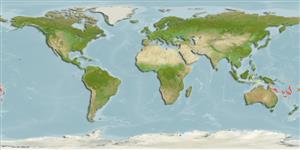
Western Central Pacific: Chesterfield Islands.
Grootte / Gewicht / Leeftijd
Maturiteit: Lm ? range ? - ? cm
Max length : 34.2 cm TL mannelijk / geslacht onbekend; (Ref. 51067)
Korte beschrijving
Determinatiesleutels | Morfologie | Morfometrie
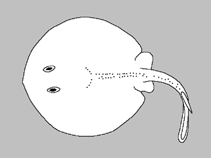
Dorsale stekels (totaal) : 0; Wervels: 151 - 157. Weakly rhomboidal disc, width less than 70% total length; rather long tail, postcoacal length more than 75% of disc length; short head (ventral length mostly less than 30% total length) and snout (length to eye less than 15% total length); narrow, cartilaginous interorbit less than 4% total length; internasal flap greatly expanded posteriorly; no broad lobes on posterolateral border of nostrils; inner margin of spiracle oblique; no lateral tail folds; no dorsal fin; apices of pelvic fins rounded; 7-8 oral papillae arranged along a 'W' line on mouth floor; 96-102 pectoral fin radials; total vertebrae more than 150; dorsal surface uniform yellowish brown (Ref. 51067).
Body shape (shape guide): other.
Inhabits the continental slope (Ref. 51067).
Levenscyclus en paargedrag
Maturiteit | Voortplanting | Paaien | Eieren | Fecunditeit | Larven
Séret, B. and P. Last, 2003. Description of four new stingarees of the genus Urolophus (Batoidea: Urolophidae) from the Coral Sea, South-West Pacific. Cybium 27(4):307-320. (Ref. 51067)
Status op de Rode Lijst van het IUCN (Ref. 130435: Version 2025-2 (Global))
Gevaar voor de mens
Harmless
Gebruik door de mens
Tools
Speciale rapporten
Download XML
Internetbronnen
Schattingen op basis van modellen
Gewenste temperatuur (Ref.
123201): 4.2 - 5.6, mean 4.8 °C (based on 48 cells).
Fylogenetische diversiteitsindex (Ref.
82804): PD
50 = 0.5000 [Uniqueness, from 0.5 = low to 2.0 = high].
Bayesian length-weight: a=0.00813 (0.00371 - 0.01783), b=3.08 (2.87 - 3.29), in cm total length, based on LWR estimates for this (Sub)family-body shape (Ref.
93245).
Trofisch niveau (Ref.
69278): 3.5 ±0.4 se; based on size and trophs of closest relatives
Weerstandsvermogen (Ref.
120179): laag, minimale populatieverdubbelingstijd 4,5-14 jaar (Assuming fecundity<100).
Kwetsbaarheid van de visserij (Ref.
59153): Low vulnerability (24 of 100).
🛈