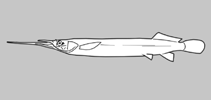
Clasificación / Nombres
Nombres comunes | Sinónimos | Catalog of Fishes(Género, Especie) | ITIS | CoL | WoRMS | Cloffa
>
Beloniformes (Needle fishes) >
Zenarchopteridae (Internally fertilized halfbeaks)
Etymology: Dermogenys: Greek, derma = skin + Greek, geny, -yos = face, jaw (Ref. 45335); bruneiensis: Named after country of type locality, Brunei.
Entorno: milieu / zona climática / rango de profundidad / gama de distribución
Ecología
; agua dulce pelágico. Tropical
Asia: endemic to Brunei.
Tamaño / Peso / Edad
Madurez: Lm ? range ? - ? cm
Max length : 3.4 cm SL macho / no sexado; (Ref. 44897); 5.5 cm SL (female)
Collected from coastal, black waters throughout Brunei (taken from L.R. Parenti's field notes at USNM). The streams where specimens were collected either ran through Nipa or dipterocarp vegetation. Species collected at more than one of the stations include: the phallostethids
Neostethus borntiensis, N. bicornis; the gobies Stimatogobius borneensis, Bruchygobius doriae, Mugilogobius rambaiae, Hemigobius sp.; the puffer Tetraodon leirus; and eleotrids Bostryhus sp. and Ophiocara pomcephala; also a species of Zenarchopterus was collected at one station (Ref. 44897).
Ciclo vital y comportamiento de apareamiento
Madurez | Reproducción | Puesta | Huevos | Fecundidad | Larva
Meisner, A.D., 2001. Phylogenetic systematics of the viviparous halfbeak genera Dermogenys and Nomorhamphus (Teleostei: Hemiramphidae: Zenarchopterinae). Zool. J. Linn. Soc. 133:199-283. (Ref. 44897)
Situación en la Lista Roja de la UICN (Ref. 130435: Version 2025-2 (Global))
Amenaza para el ser humano
Harmless
Usos humanos
Herramientas
Informes especiales
Descargar XML
Fuentes de Internet
Estimaciones basadas en modelos
Índice de diversidad filogenética (Referencia
82804): PD
50 = 0.5001 [Uniqueness, from 0.5 = low to 2.0 = high].
Bayesian length-weight: a=0.00457 (0.00198 - 0.01053), b=3.03 (2.83 - 3.23), in cm total length, based on LWR estimates for this (Sub)family-body shape (Ref.
93245).
Nivel trófico (Referencia
69278): 3.1 ±0.4 se; based on size and trophs of closest relatives
Vulnerabilidad pesquera (Ref.
59153): Low vulnerability (10 of 100).
🛈