Klassifizierung / Names
Namen | Synonyme | Catalog of Fishes(Gattung, Arten) | ITIS | CoL | WoRMS | Cloffa
>
Siluriformes (Catfishes) >
Loricariidae (Armored catfishes) > Hypostominae
Etymology: Peckoltia: Because of Gustavo Peckolt,member of the Natural History Commission of Rondon (Ref. 45335); sabaji: Named for Dr. Mark Henry Sabaj, collection manager of Ichthyology, Academy of Natural Sciences of Philadelphia, for his tremendous help in collecting specimens throughout South America (Ref. 50590).
Eponymy: Gustavo Peckolt (1861–1923) was a Brazilian-born German botanist and pharmacist. [...] Dr Mark Henry Sabaj Pérez (d: 1969) is an ichthyologist and collection manager of fishes at the Academy of Natural Sciences of Philadelphia (2000–present). [...] (Ref. 128868), visit book page.
Taxonomic Remarks
Placed under Ancistomus in the aquarium domain.
Umwelt: Milieu / Klimazone / Tiefenbereich / Verbreitungsgebiet
Ökologie
; süßwasser demersal. Tropical; 6°N - 1°N, 68°W - 58°W
South America: Guyana and Venezuela.
Größe / Gewicht / Alter
Geschlechtsreife: Lm ? range ? - ? cm
Max length : 19.8 cm SL Männchen/unbestimmt; (Ref. 50590)
Kurzbeschreibung
Bestimmungsschlüssel | Morphologie | Morphometrie
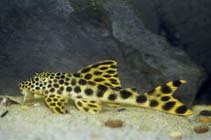
Rückenflossenstacheln (insgesamt) : 2; Rückenflossenweichstrahlen (insgesamt) : 7; Afterflossenstacheln: 1; Afterflossenweichstrahlen: 4. Small spots on the head with spots becoming very large on the caudal peduncle and caudal fin; body very elongated; odontodes on opercle absent, rarely with one or two odontodes in adults (Ref. 50590).
Body shape (shape guide): elongated.
Facultative air-breathing in the genus (Ref. 126274); Found in medium to large rivers among boulders, usually in runs and riffles. Small individuals may be found hidden in the holes of lateritic rocks in pools and most specimens were collected at night. The largest individual was captured in a gill net in the main stem Essequibo and this individual apeared to be moving from deeper water into the shallows where there were exposed boulders (Ref. 50590).
Lebenszyklus und Paarungsverhalten
Geschlechtsreife | Fortpflanzung | Ablaichen | Eier | Fruchtbarkeit | Larven
Armbruster, J.W., 2003. Peckoltia sabaji, a new species from the Guyana Shield (Siluriformes: Loricariidae). Zootaxa 344:1-12. (Ref. 50590)
IUCN Rote Liste Status (Ref. 130435: Version 2025-2 (Global))
Bedrohung für Menschen
Harmless
Nutzung durch Menschen
Fischereien: nicht kommerziell
Tools
Zusatzinformationen
Download XML
Internet Quellen
Schätzungen auf der Grundlage von Modellen
Phylogenetischer Diversitätsindex (Ref.
82804): PD
50 = 0.5000 [Uniqueness, from 0.5 = low to 2.0 = high].
Bayesian length-weight: a=0.01479 (0.00826 - 0.02648), b=2.98 (2.83 - 3.13), in cm total length, based on LWR estimates for this species & (Sub)family-body (Ref.
93245).
Widerstandsfähigkeit (Ref.
120179): mittel, Verdopplung der Population dauert 1,4 - 4,4 Jahre. (Preliminary K or Fecundity.).
Anfälligkeit der Fischerei (Ref.
59153): Low vulnerability (14 of 100).
🛈