>
Ovalentaria/misc (Various families in series Ovalentaria) >
Pseudochromidae (Dottybacks) > Pseudoplesiopinae
Etymology: Pseudoplesiops: Greek, pseudes = false + Greek, plesios = near (Ref. 45335); wassi: Named for R.C. Wass, who first reported on the species, in recognition of his important contribution to our knowledge of South-West Pacfic fishes (Ref. 50540).
Eponymy: Dr Richard Charles Wass (d: 1942) was the fisheries officer of the US Fish & Wildlife Service who collected many fishes in American Samoa in the 1970s and early 1980s. [...] (Ref. 128868), visit book page.
More on authors: Gill & Edwards.
Umwelt: Milieu / Klimazone / Tiefenbereich / Verbreitungsgebiet
Ökologie
seewasser riff-verbunden; tiefenbereich 1 - 60 m (Ref. 90102). Tropical
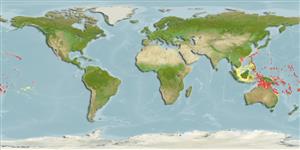
Pacific Ocean: Micronesia and Australia to American Samoa.
Größe / Gewicht / Alter
Geschlechtsreife: Lm ? range ? - ? cm
Max length : 2.9 cm SL Männchen/unbestimmt; (Ref. 50540)
Kurzbeschreibung
Bestimmungsschlüssel | Morphologie | Morphometrie
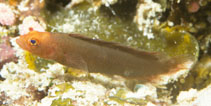
Rückenflossenstacheln (insgesamt) : 1; Rückenflossenweichstrahlen (insgesamt) : 27 - 29; Afterflossenstacheln: 2; Afterflossenweichstrahlen: 16 - 18. Caudal fin rounded or truncate to slightly emarginate (Ref. 50540).
Body shape (shape guide): elongated; Cross section: compressed.
Found in rock and coral reef habitats, including surge channels, reef slopes and drop-offs (Ref. 50540). Cryptic and seldom seen (Ref 90102).
Lebenszyklus und Paarungsverhalten
Geschlechtsreife | Fortpflanzung | Ablaichen | Eier | Fruchtbarkeit | Larven
Gill, A.C. and A.J. Edwards, 2003. Pseudoplesiops wassi, a new species of dottyback fish (Teleostei: Pseudochromidae: Pseudopleiopinae) from the West Pacific. Zootaxa 291:1-7. (Ref. 50540)
IUCN Rote Liste Status (Ref. 130435: Version 2025-2 (Global))
Bedrohung für Menschen
Harmless
Nutzung durch Menschen
Fischereien: nicht kommerziell
Tools
Zusatzinformationen
Download XML
Internet Quellen
Schätzungen auf der Grundlage von Modellen
Bevorzugte Temperatur (Ref.
123201): 26.1 - 28.9, mean 27.8 °C (based on 230 cells).
Phylogenetischer Diversitätsindex (Ref.
82804): PD
50 = 0.5005 [Uniqueness, from 0.5 = low to 2.0 = high].
Bayesian length-weight: a=0.00447 (0.00171 - 0.01168), b=3.10 (2.87 - 3.33), in cm total length, based on LWR estimates for this (Sub)family-body shape (Ref.
93245).
Trophische Ebene (Ref.
69278): 3.2 ±0.5 se; based on size and trophs of closest relatives
Anfälligkeit der Fischerei (Ref.
59153): Low vulnerability (10 of 100).
🛈
Nährstoffe (Ref.
124155): Calcium = 335 [153, 755] mg/100g; Iron = 1.34 [0.65, 2.58] mg/100g; Protein = 18.2 [16.9, 19.5] %; Omega3 = 0.134 [0.059, 0.309] g/100g; Selenium = 33.4 [11.2, 90.0] μg/100g; VitaminA = 149 [38, 568] μg/100g; Zinc = 3.26 [1.89, 5.15] mg/100g (wet weight);