>
Cyprinodontiformes (Rivulines, killifishes and live bearers) >
Aphaniidae (Oriental killifishes)
Etymology: Apricaphanius: Name from the Latin substantive Apricus, meaning 'shining', alluding to the many small white spots on the flanks of the male, which give them a shiny appearance.
Milieu: milieu / Klimaatzone / Diepte / verspreidingsgebied
Ecologie
; zoet water benthopelagisch; standvastig (Ref. 138297). Temperate
Europe: Spain along Atlantic coast between Huelva and Gulf of Cadiz, known from 9 localities (extirpated in one of them ).
Grootte / Gewicht / Leeftijd
Maturiteit: Lm ? range ? - ? cm
Max length : 3.3 cm SL mannelijk / geslacht onbekend; (Ref. 126233)
Korte beschrijving
Determinatiesleutels | Morfologie | Morfometrie
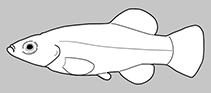
Anale zachte stralen: 11. Distinguished from congeners of Aphanius and other species of Valenciidae and Fundulidae in Europe by the following characters: males have dark grey caudal fin, with a distinct submarginal bar and 4-5 vertical rows of hyaline dots sometimes organized into regular bars; males possess 14-17 dark grey bars on a silvery background, bars irregularly shaped and set, often connected; females have a few large black spots on side, usually organized into two rows, one on middle of flank, one level with pectoral base; 24-26 scales in lateral line series on body; pectoral fin with 9-10 rays; and anal fin usually with 9 rays (Ref. 59043).
Body shape (shape guide): fusiform / normal.
Adults inhabit lagoons, tidal canals and small, shallow coastal streams, with water fresh to hypersaline and with silt bottom. Omnivorous, feeding on zooplankton, small insects, vegetal matter and detritus. Freshwater populations are threatened due to the introduction of Gambusia holbrooki and Fundulus heteroclitus (Ref. 59043).
Individuals born in spring mature at 3-4 months and spawn the same year; those born later spawn the following year (Ref. 59043).
Freyhof, J. and B. Yoğurtçuoğlu, 2020. A proposal for a new generic structure of the killifish family Aphaniidae, with the description of Aphaniops teimorii (Teleostei: Cyprinodontiformes). Zootaxa 4810(3):421-451. (Ref. 126233)
Status op de Rode Lijst van het IUCN (Ref. 130435: Version 2025-2 (Global))
Gevaar voor de mens
Harmless
Gebruik door de mens
Tools
Speciale rapporten
Download XML
Internetbronnen
Schattingen op basis van modellen
Fylogenetische diversiteitsindex (Ref.
82804): PD
50 = 0.6250 [Uniqueness, from 0.5 = low to 2.0 = high].
Bayesian length-weight: a=0.00933 (0.00418 - 0.02084), b=3.21 (3.03 - 3.39), in cm total length, based on LWR estimates for this (Sub)family-body shape (Ref.
93245).
Trofisch niveau (Ref.
69278): 3.0 ±0.4 se; based on size and trophs of closest relatives
Generation time: 0.7 ( na - na) years. Estimated as median ln(3)/K based on 1
growth studies.
Weerstandsvermogen (Ref.
120179): Hoog, minimale populatieverdubbelingstijd minder dan 15 maanden (Assuming tm<1).
Kwetsbaarheid van de visserij (Ref.
59153): Low vulnerability (10 of 100).
🛈