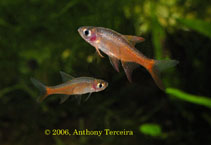
Klassifizierung / Names
Namen | Synonyme | Catalog of Fishes(Gattung, Arten) | ITIS | CoL | WoRMS | Cloffa
Umwelt: Milieu / Klimazone / Tiefenbereich / Verbreitungsgebiet
Ökologie
; süßwasser benthopelagisch; pH range: 6.0 - 6.0; dH range: 5 - 8. Tropical; 25°C - 29°C (Ref. 2060); 7°N - 6°N
Asia: restricted to the Kalu basin, Sri Lanka.
Größe / Gewicht / Alter
Geschlechtsreife: Lm ? range ? - ? cm
Max length : 4.0 cm TL Männchen/unbestimmt; (Ref. 6028)
Rückenflossenweichstrahlen (insgesamt) : 10; Afterflossenweichstrahlen: 8 - 9; Wirbelzahl: 29. Rasboroides vaterifloris is distinguished from its congener R. nigromarginatus by the location of pelvic-fin origin which is midway between the pectoral-fin base and anal-fin origin (vs. closer to anal-fin origin), by having the dorsal margin of the operculum more or less straight (vs. with a deep indentation), and the dorsal profile of the head approximately straight (vs. slightly concave) behind the level of the eye in males. Males of R. vaterifloris can be diagnosed from
those of R. nigromarginatus by having a greater interorbital width (29-33 % HL, vs. 17-22) and a greater internarial width (19-21 % HL, vs. 11-17), while females differ by having a greater anal-fin depth (23.5-24.8 % SL, vs. 17.4-22.7), a greater interorbital width (25-33 % HL, vs. 16-21), a greater caudal-peduncle depth (12.4-13.4 % SL, vs. 10.4-12.3) and a lesser caudal-peduncle length (18.6-21.2 % SL, vs. 21.1-25.0). It differs from R. pallidus and R. rohani by having the dorsal-fin origin 1 scale-width (vs. 3 scale-widths) behind the pelvic-fin origin and a
lesser body depth of 31.0-32.8 % SL (vs. 33.0-37.5 in R. pallidus and 33.3-40.0 in R. rohani) (Ref. 94541).
Body shape (shape guide): fusiform / normal.
Occurs in shallow, cool, clear, quiet, heavily shaded forest streams, usually with a silty substrate and often in areas with a large amount of leaf debris in the water. Feeds on terrestrial insects (Diptera and Coleoptera, see Ref. 6469) and detritus. Males slimmer and brightly colored than females.
Lebenszyklus und Paarungsverhalten
Geschlechtsreife | Fortpflanzung | Ablaichen | Eier | Fruchtbarkeit | Larven
A prolific breeder. The courtship ritual is frenetic; several batches of about 20 eggs are spawned among submerged marginal vegetation during the course of about 30 minutes. The eggs sink, and hatch in about 36 hours. The free-swimming fry are very delicate and sensitive to water conditions.
Pethiyagoda, R., 1991. Freshwater fishes of Sri Lanka. The Wildlife Heritage Trust of Sri Lanka, Colombo. 362 p. (Ref. 6028)
IUCN Rote Liste Status (Ref. 130435: Version 2025-2 (Global))
Bedrohung für Menschen
Harmless
Nutzung durch Menschen
Fischereien: nicht kommerziell; Aquarium: Kommerziell
Tools
Zusatzinformationen
Download XML
Internet Quellen
Schätzungen auf der Grundlage von Modellen
Phylogenetischer Diversitätsindex (Ref.
82804): PD
50 = 0.5625 [Uniqueness, from 0.5 = low to 2.0 = high].
Bayesian length-weight: a=0.00891 (0.00382 - 0.02082), b=3.02 (2.82 - 3.22), in cm total length, based on LWR estimates for this (Sub)family-body shape (Ref.
93245).
Trophische Ebene (Ref.
69278): 2.8 ±0.32 se; based on food items.
Widerstandsfähigkeit (Ref.
120179): hoch, Verdopplung der Population dauert weniger als 15 Monate. (Preliminary K or Fecundity.).
Anfälligkeit der Fischerei (Ref.
59153): Low vulnerability (10 of 100).
🛈