Classificazione / Nomi
Nomi Comuni | Sinonimi | Catalog of Fishes(Genere, Specie) | ITIS | CoL | WoRMS | Cloffa
>
Cypriniformes (Carps) >
Cyprinidae (Minnows or carps) > Smiliogastrinae
Etymology: Dawkinsia: Named for Richard Dawkins, for his contribution to the public understanding of science and, in particular, of evolutionary science.
Eponymy: Dr Clinton Richard Dawkins (d: 1941) is an ethologist and evolutionary biologist who was Professor for Public Understanding of Science (1995–2008) at Oxford, which had awarded both his bachelor’s degree (1962) and his doctorate (1966) and where he [...] (Ref. 128868), visit book page.
Ambiente: milieu / zona climatica / distribuzione batimetrica / gamma di distribuzione
Ecologia
; acqua dolce benthopelagico. Tropical
Asia: restricted to the eastern slopes of the Knuckles Hills in the Kalu River at Pallegama, Sri Lanka at elevations of 300-500 m. Very rare and the only known existing population is in imminent danger of extinction due to the siltation of the Kalu caused by gem mining upstream.
Dimensione / Peso / Età
Maturità: Lm ? range ? - ? cm
Max length : 10.0 cm TL maschio/sesso non determinato; (Ref. 6028)
Breve descrizione
Chiavi di identificazione | Morfologia | Morfometria
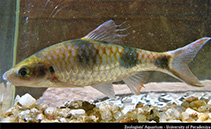
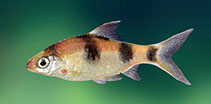
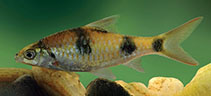
Adults of Puntius srilankensis are distinguished from P. filamentosus, P. singhala and P. assimilis by possessing a prominent black markings on body anterior to anal-fin origin. They differ from P. exclamatio by the absence of an elongate, tear-shaped black blotch above and anal fin; from P. arulius and P. tambraparniei by having mouth inferior and lower lip medially absent ( vs. mouth subterminal, lower lip entire) (Ref. 55036).
Body shape (shape guide): fusiform / normal.
A mid-water fish found in areas of rapidly flowing water with pebbly substrate (not found in silty substrate). With a clearly defined territory (of several square meters) and without lateral spatial preferences. Individuals of the same size often form loose schools. Presently not available in sufficient numbers to be exported by the aquarium trade.
Ciclo vitale e comportamento di accoppiamento
Maturità | Riproduzione | Deposizione | Uova | Fecondità | Larve
Pethiyagoda, R., 1991. Freshwater fishes of Sri Lanka. The Wildlife Heritage Trust of Sri Lanka, Colombo. 362 p. (Ref. 6028)
Stato della Lista Rossa IUCN (Ref. 130435: Version 2025-2 (Global))
Minaccia per l'uomo
Harmless
Usi umani
Pesca: di nessun interesse; Acquario: Potenziale
Strumenti
Rapporti speciali
Scarica XML
Fonti Internet
Stime basate su modelli
Indice di diversità filogenetica (Fonte Biblio.
82804): PD
50 = 0.5001 [Uniqueness, from 0.5 = low to 2.0 = high].
Bayesian length-weight: a=0.01072 (0.00504 - 0.02277), b=3.02 (2.84 - 3.20), in cm total length, based on LWR estimates for this (Sub)family-body shape (Ref.
93245).
Livello trofico (Fonte Biblio.
69278): 2.7 ±0.1 se; based on size and trophs of closest relatives
Resilienza (Fonte Biblio.
120179): Alto, tempo minimo di raddoppiamento della popolazione meno di 15 mesi (Preliminary K or Fecundity.).
Vulnerabilità della pesca (Ref.
59153): Low vulnerability (10 of 100).
🛈