Klassifizierung / Names
Namen | Synonyme | Catalog of Fishes(Gattung, Arten) | ITIS | CoL | WoRMS | Cloffa
>
Carangaria/misc (Various families in series Carangaria) >
Polynemidae (Threadfins)
Etymology: Polynemus: Greek, poly = a lot of + Greek,nema = filament (Ref. 45335); aquilonaris: From the Latin for northern, in reference to the northern distribution (Indochina) of the species, compared with that of the related Polynemus dubius (Ref. 49954).
Umwelt: Milieu / Klimazone / Tiefenbereich / Verbreitungsgebiet
Ökologie
; süßwasser; brackwasser demersal. Tropical
Asia: Chao Phraya and Mekong River systems and from Lake Tonle Sap and related rivers.
Größe / Gewicht / Alter
Geschlechtsreife: Lm ? range ? - ? cm
Max length : 15.8 cm SL Männchen/unbestimmt; (Ref. 49954)
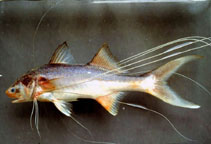
Rückenflossenstacheln (insgesamt) : 9; Rückenflossenweichstrahlen (insgesamt) : 15 - 19; Afterflossenstacheln: 3; Afterflossenweichstrahlen: 11 - 13; Wirbelzahl: 25. Eight first dorsal fin spines; 7 pectoral filaments, upper 2 filaments longer than TL; vomer with villiform teeth; orbit diameter 4% of SL; posterior portion of maxilla less than orbit diameter (Ref. 49954).
Body shape (shape guide): fusiform / normal.
Found on sandy or muddy bottoms of freshwater rivers and estuaries (Ref. 49954). Feeds on small crustaceans, small fishes, and benthic organisms (Ref. 57343). Exported to Japan as an ornamental fish (Ref. 57343). Esteemed food fish in the Chao Phraya and Mekong rivers and at Tonle Sap Lake (Ref. 57343).
Lebenszyklus und Paarungsverhalten
Geschlechtsreife | Fortpflanzung | Ablaichen | Eier | Fruchtbarkeit | Larven
Motomura, H., 2004. Threadfins of the world (Family Polynemidae). An annotated and illustrated catalogue of polynemid species known to date. FAO Spec. Cat. Fish. Purp. Rome: FAO. 3:117 p. (Ref. 57343)
IUCN Rote Liste Status (Ref. 130435: Version 2025-2 (Global))
Bedrohung für Menschen
Harmless
Nutzung durch Menschen
Fischereien: kommerziell; Aquarium: Kommerziell
Tools
Zusatzinformationen
Download XML
Internet Quellen
Schätzungen auf der Grundlage von Modellen
Phylogenetischer Diversitätsindex (Ref.
82804): PD
50 = 0.5039 [Uniqueness, from 0.5 = low to 2.0 = high].
Bayesian length-weight: a=0.00676 (0.00304 - 0.01503), b=3.09 (2.91 - 3.27), in cm total length, based on LWR estimates for this (Sub)family-body shape (Ref.
93245).
Trophische Ebene (Ref.
69278): 3.8 ±0.56 se; based on food items.
Widerstandsfähigkeit (Ref.
120179): hoch, Verdopplung der Population dauert weniger als 15 Monate. (Preliminary K or Fecundity.).
Anfälligkeit der Fischerei (Ref.
59153): Low vulnerability (10 of 100).
🛈