Classificação / Nomes
Nomes comuns | Sinónimos | Catalog of Fishes(Género, Espécies) | ITIS | CoL | WoRMS | Cloffa
>
Cichliformes (Cichlids, convict blennies) >
Cichlidae (Cichlids) > Pseudocrenilabrinae
Etymology: ismailiaensis: Named on geographical basis since it was collected from Ismailia City (Ref. 47362).
Ambiente: milieu / zona climática / intervalo de profundidade / gama de distribuição
Ecologia
; Água doce bentopelágico. Temperate
Africa: Ismailia Canal, Egypt (Ref. 47362).
Tamanho / Peso / Idade
Maturidade: Lm ? range ? - ? cm
Max length : 9.3 cm SL macho/indeterminado; (Ref. 47362)
Descrição breve
Chaves de identificação | Morfologia | Morfometria
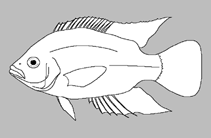
Espinhos dorsais (total) : 15; Raios dorsais moles (total) : 12 - 13; Espinhos anais: 3; Raios anais moles: 8 - 9. Head with straight profile, mouth relatively large; maxilla extending to below the anterior border of the eye; the eye relatively large with somewhat dorsolateral position; ventral outline of the body straight (Ref. 47362). Dorsal fin originating directly above the vertical of the posterior end of the operculum; posterior end of dorsal fin pointed; pectoral fin pointed; ventral fin usually reaching the vent; caudal fin truncate (Ref. 47362). Caudal peduncle as long as deep or a little deeper than long (Ref. 47362). Scales not denticulate (Ref. 47362). Unicuspid and bicuspid teeth present on the lower jaw; lower pharyngeal bone width 164% of its length (Ref. 47362).
General body colour, the groundcolour, bright grey or yellowish on the lateral sides and blackish dorsolaterally; the ventral surface rosy or blackish reddens (Ref. 47362). Nine wide vertical black bars consisting of 7 bars along the flanks extending from the back ventrally about 2/3 way beyond the midline and of two head bars; the posterior head bar extending ventrally till just above the dorsal edge of the operculum, the anterior head bar short lying dorsal to the vertical of the posterior end of the eye; two longitudinal dark stripes present, the dorsal one extending from the ventral margin of the posterior head bar till the end of the dorsal fin base, the medial stripe running nearly along the midline of the flank from the dorsal hind edge of the operculum to the base of the caudal fin (Ref. 47362). Dorsal fin with or without tilapia mark; dorsal, anal and pelvic fins with black colour; caudal fin black with blackish outer edge; the pectoral fin colourless; black opercular spot present (Ref. 47362).
Ciclo de vida e comportamento de acasalamento
Maturidade | Reprodução | Desova | Ovos | Fecundidade | Larvas
Dunz, A.R. and U.K. Schliewen, 2013. Molecular phylogeny and revised classification of the haplotilapiine cichlid fishes formerly referred to as "Tilapia". Mol. Phylogenet. Evol. 68(1):64-80. (Ref. 93285)
Categoria na Lista Vermelha da IUCN (Ref. 130435: Version 2025-2 (Global))
Ameaça para o homem
Harmless
Utilização humana
Ferramentas
Relatórios especiais
Descarregue XML
Fontes da internet
Estimativas baseadas em modelos
Índice de diversidade filogenética (Ref.
82804): PD
50 = 0.5000 [Uniqueness, from 0.5 = low to 2.0 = high].
Bayesian length-weight: a=0.01905 (0.00846 - 0.04293), b=3.01 (2.82 - 3.20), in cm total length, based on LWR estimates for this (Sub)family-body shape (Ref.
93245).
Nível Trófico (Ref.
69278): 2.7 ±0.1 se; based on size and trophs of closest relatives
Resiliência (Ref.
120179): Elevada, tempo mínimo de duplicação da população menor que 15 meses (Preliminary K or Fecundity.).
Vulnerabilidade da pesca (Ref.
59153): Low vulnerability (10 of 100).
🛈