Classification / Noms
Noms communs | Synonymes | Catalog of Fishes(Genre, Espèce) | ITIS | CoL | WoRMS | Cloffa
>
Characiformes (Characins) >
Characidae (Characins; tetras) > Cheirodontinae
Etymology: Odontostilbe: Greek, odous = teeth + Greek, stilbe, es = lamp (Ref. 45335).
More on author: Gill.
Environnement : milieu / zone climatique / profondeur / gamme de distribution
Écologie
; eau douce benthopélagique. Tropical
Central America: Trinidad Island in Trinidad and Tobago; widespread in río Orinoco basin, smaller coastal drainages of Venezuela, Lake Valencia system and the rio Essequibo basin. A spot occurrence in the upper rio Demini, rio Negro, Amazonas basin, though represented by a unique mature male.
Taille / Poids / Âge
Maturité: Lm ? range ? - ? cm
Max length : 3.7 cm SL mâle / non sexé; (Ref. 75063); 3.7 cm SL (female)
Description synthétique
Clés d'identification | Morphologie | Morphométrie
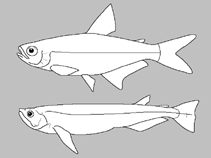
Rayons mous dorsaux (Total) : 11. Distinguished from most other members of the genus Odontostilbe by having a remarkably long anal-fin base 26.0-33.5% SL, with only Odontostilbe nareuda has a similarly long anal-fin base length 31.3-32.8% SL, but can be differentiated from Odontostilbe pulchra in having anal-fin rays 24-26 (vs. 17-24, usually 19-22 in Odontostilbe pulchra). In addition, mature males of Odontostilbe pulchra differ from Odontostilbe fugitiva, Odontostilbe ecuadorensis, Odontostilbe dierythrura, Odontostilbe parecis, Odontostilbe paraguayensis, Odontostilbe microcephala, Odontostilbe splendida, and Odontostilbe pao by possessing hooks on the 1st to 22nd anal-fin branched rays of males, practically
on all branched anal-fin rays (vs. 1st to 9th, mostly 6th-7th, anal-fin branched rays of males with hooks); distal border of anal fin slightly concave to almost straight in mature males (vs. distal border concave); longer pectoral fin passing a vertical through pelvic-fin origin (vs. shorter pectoral fin reaching but not trespassing to vertical through pelvic-fin origin), almost absence of elongation of the 2nd unbranched dorsal-fin ray (vs. noticeably elongate 2nd unbranched dorsal-fin ray). Furthermore, males, females and unsexed specimens differ from
Odontostilbe fugitiva by having longer upper jaw 26.8-32.5% HL (vs. 23.4-30.0% HL). The snout length in males separates Odontostilbe pulchra (18.0-26.0% HL, mean 21.8%) from the sympatric species Odontostilbe splendida with 24.1-26.9% HL, mean 25.2% HL, and Odontostilbe pao with 26.7-30.6 HL, mean 28.6% HL (Ref. 75063).
Body shape (shape guide): elongated; Cross section: compressed.
Cycle de vie et comportement reproducteur
Maturité | Reproduction | Frai | Œufs | Fécondité | Larves
Bührnheim, C.M. and L.R. Malabarba, 2007. Redescription of Odontostilbe pulchra (Gill, 1858) (Teleostei: Characidae: Cheirodontinae), and description of two new species from the río Orinoco basin. Neotrop. Ichthyol. 5(1):1-20. (Ref. 75063)
Statut dans la liste rouge de l'IUCN (Ref. 130435: Version 2025-2 (Global))
Menace pour l'homme
Harmless
Utilisations par l'homme
Outils
Articles particuliers
Télécharger en XML
Sources Internet
Estimations basées sur des modèles
Indice de diversité phylogénétique (Réf.
82804): PD
50 = 0.5000 [Uniqueness, from 0.5 = low to 2.0 = high].
Bayesian length-weight: a=0.00912 (0.00403 - 0.02064), b=3.06 (2.87 - 3.25), in cm total length, based on LWR estimates for this (Sub)family-body shape (Ref.
93245).
Niveau trophique (Réf.
69278): 2.5 ±0.5 se; based on size and trophs of closest relatives
Vulnérabilité de la pêche (Ref.
59153): Low vulnerability (10 of 100).
🛈