>
Blenniiformes (Blennies) >
Blenniidae (Combtooth blennies) > Salariinae
Etymology: Hypleurochilus: Greek, hypo = under + Greek, pleura = in the side of + Greek, cheilos = lip.
Miljö: miljö / Klimatzon / djupintervall / distributionsområde
Ekologi
marina; brackvatten revassocierade. Subtropical
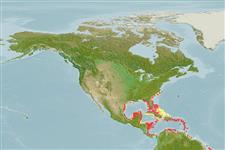
Western Central Atlantic: USA.
Storlek / Vikt / Ålder
Könsmognad: Lm ? range ? - ? cm
Max length : 5.9 cm SL hane/ej könsbestämd; (Ref. 52938)
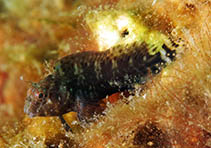
Taggstrålar i ryggfenan (totalt) : 12; Taggstrålar i analfenan: 2; Mjukstrålar i analfenan: 16. Species distinguished by: caudal fin with 3 or 4 dark bands on translucent background; segmented caudal-fin soft rays usually 13; segmented anal-fin rays usually 16 (west coast of Florida); pelvic fins with 1 spine and 3 soft rays; dorsal fin not separated into 2 portions by deep notch; dorsal-fin spines usually 12, the last easy to see; total dorsal-fin elements 25 to 30; pectoral-fin soft rays usually 13 or 14; no teeth on vomer; an enlarged canine tooth present posteriorly on both sides of 1 or both jaws (sometimes absent on 1 side); gill openings not continuous, each restricted to side of head, extending ventrally to about midlevel of pectoral-fin base or further; cirri present only on eyes; ventral edge of upper lip smooth; lateral line never consisting of 2 disconnected, overlapping portions. Common amongst Blenniids: small, slender fishes, largest species to about 13 cm SL, most under 7.5 cm SL. Eyes high on sides of head; mouth ventral, upper jaw not protractile. A single row of incisor-like teeth in each jaw and often an enlarged canine-like tooth posteriorly on each side of lower jaw and sometimes upper jaw; no teeth on palatines. Dorsal and anal fins long, their spines usually flexible; dorsal fin with fewer spines than segmented (soft) rays; 2 spines in anal fin, scarcely differentiated from the segmented rays, the first not visible in females, both often supporting fleshy, bulbous, rugose swellings at their tips in males; pelvic fins inserted anterior to base of pectoral fins, with 1 spine (not visible) and segmented rays; all segmented fin rays, except those of caudal fin, unbranched (simple), caudal-fin rays of adults branched. All species lack scales (Ref.52855).
Body shape (shape guide): elongated.
Oviparous. Eggs are demersal and adhesive (Ref. 205), and are attached to the substrate via a filamentous, adhesive pad or pedestal (Ref. 94114). Larvae are planktonic, often found in shallow, coastal waters (Ref. 94114).
Livscykel och parningsbeteende
Könsmognad | Reproduktion | Lek | Ägg | Fekunditet | Larver
Oviparous, distinct pairing (Ref. 205).
Eschmeyer, W.N. (ed.), 2003. Catalog of fishes. Updated database version of March 2003. Database dump. Catalog databases as made available to FishBase in March 2003. (Ref. 46206)
Status på IUCN:s rödlista (Ref. 130435: Version 2025-2 (Global))
Hot mot människor
Harmless
Mänskliga användningsområden
Verktyg
Särskilda rapporter
Ladda ner XML
Internet-källor
Uppskattningar baserade på modeller
Önskad temperatur (Ref.
123201): 23.3 - 27.1, mean 24.9 °C (based on 109 cells).
Index för fylogenetisk mångfald (Ref.
82804): PD
50 = 0.5005 [Uniqueness, from 0.5 = low to 2.0 = high].
Bayesian length-weight: a=0.00776 (0.00354 - 0.01702), b=3.00 (2.81 - 3.19), in cm total length, based on LWR estimates for this (Sub)family-body shape (Ref.
93245).
Trofisk nivå (Ref.
69278): 3.2 ±0.3 se; based on size and trophs of closest relatives
Resiliens (Ref.
120179): Hög, lägsta populationsfördubblingstid mindre än 15 månader (Preliminary K or Fecundity.).
Sårbarhet i fisket (Ref.
59153): Low vulnerability (10 of 100).
🛈