>
Gobiiformes (Gobies) >
Gobiidae (Gobies) > Gobiinae
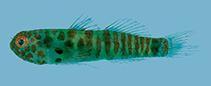
Etymology: Eviota: No etymology given, suggested by Christopher Scharpt: from Latin 'eu' for 'true' and 'iota' for anything very small, in combination 'truly very small' referring to it as being the smallest vertebrate at the time it has benn described by Jenkins (thus, making the suggestion by Scharpt plausible; disrupta: disrupta meaning broken up, in reference to the pattern of the vertical trunk bars (Ref. 5289).
More on authors: Karnella & Lachner.
Umwelt: Milieu / Klimazone / Tiefenbereich / Verbreitungsgebiet
Ökologie
seewasser riff-verbunden. Tropical
Central Pacific: Fiji, Samoa and Tonga Islands to Mangaréva (French Polynesia).
Größe / Gewicht / Alter
Geschlechtsreife: Lm ? range ? - ? cm
Max length : 1.6 cm SL Männchen/unbestimmt; (Ref. 5289)
Rückenflossenstacheln (insgesamt) : 7; Rückenflossenweichstrahlen (insgesamt) : 8 - 9; Afterflossenstacheln: 1; Afterflossenweichstrahlen: 7 - 8; Wirbelzahl: 26. Characterized by the following: base of pectoral fin with two sharply defined, circular dark spots, clearly separated, of about equal size; pectoral spots intensely pigmented, more so than trunk bars; head (dorsally) and nape with large dark spots, usually arranged transversely and discontinuous along dorsal midline; trunk with dark, discretely outlined, vertical bars, some of which are almost always irregularly broken into elongate, oval or oblong shaped marks on the anterolateral portion of the body; trunk bars extending ventrally below midside of body and often discontinuous over midline on anterior part of trunk; scale pockets on trunk not pigmented (Ref. 5289). Dorsal to anal fin-ray formula 9/8 (Ref. 116739).
Body shape (shape guide): fusiform / normal.
Lebenszyklus und Paarungsverhalten
Geschlechtsreife | Fortpflanzung | Ablaichen | Eier | Fruchtbarkeit | Larven
Karnella, S.J. and E.A. Lachner, 1981. Three new species of the Eviota epiphanes group having vertical trunk bars (Pisces: Gobiidae). Proc. Biol. Soc. Wash. 94(1):264-275. (Ref. 5289)
IUCN Rote Liste Status (Ref. 130435: Version 2025-2 (Global))
Bedrohung für Menschen
Harmless
Nutzung durch Menschen
Tools
Zusatzinformationen
Download XML
Internet Quellen
Schätzungen auf der Grundlage von Modellen
Phylogenetischer Diversitätsindex (Ref.
82804): PD
50 = 0.5000 [Uniqueness, from 0.5 = low to 2.0 = high].
Bayesian length-weight: a=0.01023 (0.00477 - 0.02194), b=3.01 (2.83 - 3.19), in cm total length, based on LWR estimates for this (Sub)family-body shape (Ref.
93245).
Trophische Ebene (Ref.
69278): 3.0 ±0.3 se; based on size and trophs of closest relatives
Widerstandsfähigkeit (Ref.
120179): hoch, Verdopplung der Population dauert weniger als 15 Monate. (Preliminary K or Fecundity.).
Anfälligkeit der Fischerei (Ref.
59153): Low vulnerability (10 of 100).
🛈