>
Gobiiformes (Gobies) >
Gobiidae (Gobies) > Gobiinae
Etymology: Eviota: No etymology given, suggested by Christopher Scharpt: from Latin 'eu' for 'true' and 'iota' for anything very small, in combination 'truly very small' referring to it as being the smallest vertebrate at the time it has benn described by Jenkins (thus, making the suggestion by Scharpt plausible; mikiae: Named for Miki Tonzuka of Bali, Indonesia, for her assistance with fish collections during the Weh Islands survey (Ref. 44113).
Eponymy: Miki Tonozuka of Bali, Indonesia, helped to collect the type. She ran ‘Dive & Dive’ with her late husband Takamasa Tonozuka (q.v.). She was honoured for her assistance in the field during the Weh Island survey. (Also see Tonozuka) (Ref. 128868), visit book page.
Ambiente: milieu / zona climatica / distribuzione batimetrica / gamma di distribuzione
Ecologia
marino associati a barriera corallina; distribuzione batimetrica 6 - 25 m (Ref. 30404). Tropical
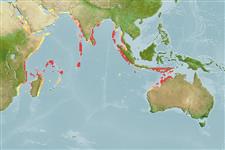
Indian Ocean: Seychelles (Amirante Islands), Chagos Archipelago, Maldives, Thailand (Andaman Sea), and Indonesia (Sumatra).
Dimensione / Peso / Età
Maturità: Lm ? range ? - ? cm
Max length : 3.5 cm TL maschio/sesso non determinato; (Ref. 30404)
Breve descrizione
Chiavi di identificazione | Morfologia | Morfometria
Spine dorsali (totale) : 7; Raggi dorsali molli (totale) : 9; Spine anali: 1; Raggi anali molli: 8. Pectoral fin rays simple; spinous dorsal fin moderately elongate in both sexes, second and third rays longest, fifth pelvic fin ray well developed, two-tenths to three-tenths length of fourth ray; cephalic sensory pore system lacking IT and PITO pores, and AITO pore single (except double in smallest paratype) and very small; posterior rays of second dorsal and anal fins elongate, forming a lanceolate shape; preserved specimens generally whitish with dark pigment along base of anal fin, extending along ventral edge of caudal peduncle; small dark spot usually present at lower caudal fin base; nostrils dark and pair of brown spots of variable intensity usually present on top of head, just behind eyes (Ref. 44113).
Body shape (shape guide): elongated; Cross section: oval.
Inhabits rich coral reef slopes with moderate tidal currents, in small groups on large coral heads (Ref. 30404, 48637).
Ciclo vitale e comportamento di accoppiamento
Maturità | Riproduzione | Deposizione | Uova | Fecondità | Larve
Allen, G.R., 2001. Description of two new gobies (Eviota, Gobiidae) from Indonesian seas. aqua, J. Ichthyol. Aquat. Biol. 4(4):125-130. (Ref. 44113)
Stato della Lista Rossa IUCN (Ref. 130435: Version 2025-2 (Global))
Minaccia per l'uomo
Harmless
Usi umani
Strumenti
Rapporti speciali
Scarica XML
Fonti Internet
Stime basate su modelli
Temperatura preferita (Fonte Biblio.
123201): 27 - 29.3, mean 28.4 °C (based on 563 cells).
Indice di diversità filogenetica (Fonte Biblio.
82804): PD
50 = 0.5000 [Uniqueness, from 0.5 = low to 2.0 = high].
Bayesian length-weight: a=0.00692 (0.00281 - 0.01706), b=3.09 (2.92 - 3.26), in cm total length, based on LWR estimates for this Genus-body shape (Ref.
93245).
Livello trofico (Fonte Biblio.
69278): 3.1 ±0.3 se; based on size and trophs of closest relatives
Resilienza (Fonte Biblio.
120179): Alto, tempo minimo di raddoppiamento della popolazione meno di 15 mesi (Preliminary K or Fecundity.).
Vulnerabilità della pesca (Ref.
59153): Low vulnerability (10 of 100).
🛈
Nutrienti (Ref.
124155): Calcium = 335 [145, 854] mg/100g; Iron = 1.37 [0.62, 2.92] mg/100g; Protein = 17.7 [15.6, 19.5] %; Omega3 = 0.102 [0.038, 0.257] g/100g; Selenium = 31.5 [10.7, 85.1] μg/100g; VitaminA = 111 [24, 478] μg/100g; Zinc = 3.59 [2.08, 5.80] mg/100g (wet weight);