>
Gobiiformes (Gobies) >
Gobiidae (Gobies) > Gobiinae
Etymology: Eviota: No etymology given, suggested by Christopher Scharpt: from Latin 'eu' for 'true' and 'iota' for anything very small, in combination 'truly very small' referring to it as being the smallest vertebrate at the time it has benn described by Jenkins (thus, making the suggestion by Scharpt plausible; raja: Named in reference to the type locality, Raja Ampat Islands (Ref. 44113).
Entorno: milieu / zona climática / rango de profundidad / gama de distribución
Ecología
marino asociado a arrecife, usually 4 - 12 m (Ref. 44113). Tropical
Western Central Pacific: Indonesia (Raja Ampat Islands).
Tamaño / Peso / Edad
Madurez: Lm ? range ? - ? cm
Max length : 2.4 cm SL macho / no sexado; (Ref. 44113)
Descripción breve
Claves de identificación | Morfología | Morfometría
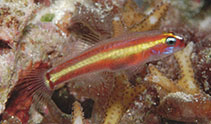
Espinas dorsales (total) : 7; Radios blandos dorsales (total) : 9 - 10; Espinas anales: 1; Radios blandos anales: 8 - 9. Pectoral fin rays simple; spinous dorsal fin elongate or filamentous in both sexes, first to third (rarely fourth) longest; fifth pelvic fin ray well developed, five-tenths to nine-tenths length of fourth ray; cephalic sensory pore system lacking IT and PITO pores, and AITO pore single (except double in smallest paratype) and very large; posterior rays of second dorsal and anal fins elongate, forming a lanceolate shape; membranes of dorsal and anal fins slightly dusky; lower portion of caudal peduncle dusky and pair of vertically elongate black spots at upper and lower caudal fin base, their upper and lower edges often joined or nearly joined at middle of caudal peduncle, especially in mature adults (Ref. 44113).
Body shape (shape guide): elongated.
Found in sheltered reef slopes (Ref. 44113). Forms aggregations of 10-20 individuals among branching coral (Ref. 44113).
Ciclo vital y comportamiento de apareamiento
Madurez | Reproducción | Puesta | Huevos | Fecundidad | Larva
Allen, G.R., 2001. Description of two new gobies (Eviota, Gobiidae) from Indonesian seas. aqua, J. Ichthyol. Aquat. Biol. 4(4):125-130. (Ref. 44113)
Situación en la Lista Roja de la UICN (Ref. 130435: Version 2025-2 (Global))
Amenaza para el ser humano
Harmless
Usos humanos
Herramientas
Informes especiales
Descargar XML
Fuentes de Internet
Estimaciones basadas en modelos
Índice de diversidad filogenética (Referencia
82804): PD
50 = 0.5000 [Uniqueness, from 0.5 = low to 2.0 = high].
Bayesian length-weight: a=0.00692 (0.00281 - 0.01706), b=3.09 (2.92 - 3.26), in cm total length, based on LWR estimates for this Genus-body shape (Ref.
93245).
Nivel trófico (Referencia
69278): 3.1 ±0.3 se; based on size and trophs of closest relatives
Resiliencia (Referencia
120179): Alto, población duplicada en un tiempo mínimo inferior a 15 meses (Preliminary K or Fecundity.).
Vulnerabilidad pesquera (Ref.
59153): Low vulnerability (10 of 100).
🛈
Nutrientes (Ref.
124155): Calcium = 423 [174, 1,289] mg/100g; Iron = 1.61 [0.68, 3.65] mg/100g; Protein = 17.6 [15.4, 19.4] %; Omega3 = 0.103 [0.033, 0.300] g/100g; Selenium = 32.9 [9.3, 100.9] μg/100g; VitaminA = 120 [22, 601] μg/100g; Zinc = 4.55 [2.45, 7.68] mg/100g (wet weight);