>
Lophiiformes (Anglerfishes) >
Oneirodidae (Dreamers)
Etymology: Puck: From the Germanic folklore, a minor order of mischievous devils, sprites, goblins, and demons; a devilish trickster (Ref. 86949).
Eponymy: Puck is a fairy in the service of Oberon (see Shakespeare’s: A Midsummers Night’s Dream), one of three Shakespearean names coined in the same paper (see O. [...] (Ref. 128868), visit book page.
Ambiente: milieu / zona climatica / distribuzione batimetrica / gamma di distribuzione
Ecologia
marino batipelagico; distribuzione batimetrica 1464 - 4073 m (Ref. 86949). Deep-water
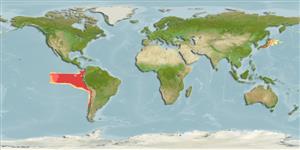
Northwest Pacific: known from the type locality, 38°16'N, 152°34'E and Galapagos Islands (Ref. 86949).
Dimensione / Peso / Età
Maturità: Lm ? range ? - ? cm
Max length : 8.1 cm SL maschio/sesso non determinato; (Ref. 86949)
Breve descrizione
Chiavi di identificazione | Morfologia | Morfometria
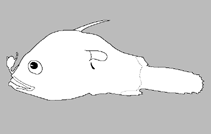
Raggi dorsali molli (totale) : 5; Raggi anali molli: 4. Metamorphosed females distinguished by the following characteristics: wide ethmoid cartilage and vomer, wider than distance between anterolateral tips of lateral ethmoids and frontals; presence of vomerine teeth; nasal foramina large and oval in shape; short frontals, lying posterior to the ethmoid region, strongly convex dorsal margin; ventromedial extensions of frontals approach each other on midline, making contact with parasphenoid; frontals separated from prootics; presence of pterosphenoid; anterior end of illicial trough wider and shallower than posterior end; extremely well developed sphenotic spines; symphysial cartilage of upper jaw longer than wide; lower jaw with well developed symphysial spine; hyomandibula with double head; extremely well developed quadrate spine, nearly six times the length of articular spine; deeply notched posterior margin of opercle; subopercle small, elongate and narrow throughout its length, dorsal end tapering to a point, rounded ventral end; absence of first pharyngobranchial; well developed second pharyngobranchial; second hypobranchial directly articulates with second basibranchial; caudal fin rays without internal pigmentation; illicium longer than length of esca bulb; pterygoiphore of illicium cylindrical throughout its length, emerging on snout from between frontal bones, anterior end slightly exposed, posterior end concealed beneath skin; well developed first ray of dorsal fin; dorsal fin rays 5; anal fin rays 4; long and narrow pectoral fin lobe, longer than longest rays of pectoral fin; pectoral fin rays 19-20; coracoid lacking posteroventral process; simple pelvic bones, slightly expanded distally; skin is naked, without dermal spinules; darkly pigmented skin of caudal peduncle extends well past base of caudal fin (Ref. 86949).
Presumably bathypelagic.
Ciclo vitale e comportamento di accoppiamento
Maturità | Riproduzione | Deposizione | Uova | Fecondità | Larve
Eschmeyer, W.N. (ed.), 2003. Catalog of fishes. Updated database version of March 2003. Database dump. Catalog databases as made available to FishBase in March 2003. (Ref. 46206)
Stato della Lista Rossa IUCN (Ref. 130435: Version 2025-2 (Global))
Minaccia per l'uomo
Harmless
Usi umani
Pesca: di nessun interesse
Strumenti
Rapporti speciali
Scarica XML
Fonti Internet
Stime basate su modelli
Temperatura preferita (Fonte Biblio.
123201): 1.7 - 2.6, mean 2.3 °C (based on 71 cells).
Indice di diversità filogenetica (Fonte Biblio.
82804): PD
50 = 1.0000 [Uniqueness, from 0.5 = low to 2.0 = high].
Bayesian length-weight: a=0.01995 (0.00906 - 0.04395), b=3.01 (2.83 - 3.19), in cm total length, based on all LWR estimates for this body shape (Ref.
93245).
Livello trofico (Fonte Biblio.
69278): 3.8 ±0.6 se; based on size and trophs of closest relatives
Resilienza (Fonte Biblio.
120179): Alto, tempo minimo di raddoppiamento della popolazione meno di 15 mesi (Preliminary K or Fecundity.).
Vulnerabilità della pesca (Ref.
59153): Low vulnerability (10 of 100).
🛈