Klassifizierung / Names
Namen | Synonyme | Catalog of Fishes(Gattung, Arten) | ITIS | CoL | WoRMS | Cloffa
Umwelt: Milieu / Klimazone / Tiefenbereich / Verbreitungsgebiet
Ökologie
seewasser; brackwasser benthopelagisch. Tropical
Eastern Pacific: Nicaragua to Peru (Ref. 9312). Mexico and Sea of cortez (Ref. 97273)
Größe / Gewicht / Alter
Geschlechtsreife: Lm ? range ? - ? cm
Max length : 100.0 cm TL Männchen/unbestimmt; (Ref. 9312); common length : 50.0 cm TL Männchen/unbestimmt; (Ref. 9312)
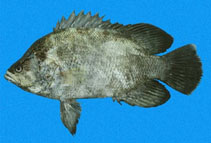
Body deep and moderately compressed, the depth much greater than head length; eyes small; upper jaw scarcely protractile; vomer, palate and tongue toothless; nostrils round and close together; preopercle distinctly serrated; lower branch of first gill arch with 15 gill rakers; in large individuals, the dorsal and anal fins, along with the caudal fin, appear like 3 caudal fins; body olive colored, speckled with dark spots; juveniles yellowish with dark spots (Ref. 55763).
Body shape (shape guide): short and / or deep.
Feeds mainly on benthic crustaceans and small fishes (Ref. 9312).
Lebenszyklus und Paarungsverhalten
Geschlechtsreife | Fortpflanzung | Ablaichen | Eier | Fruchtbarkeit | Larven
Heemstra, P.C., 1995. Lobotidae. Dormilonas. p. 1226. In W. Fischer, F. Krupp, W. Schneider, C. Sommer, K.E. Carpenter and V. Niem (eds.) Guia FAO para Identification de Especies para lo Fines de la Pesca. Pacifico Centro-Oriental. 3 Vols. FAO, Rome. (Ref. 9312)
IUCN Rote Liste Status (Ref. 130435: Version 2025-2 (Global))
Bedrohung für Menschen
Harmless
Nutzung durch Menschen
Fischereien: kommerziell; Sportfisch: ja
Tools
Zusatzinformationen
Download XML
Internet Quellen
Schätzungen auf der Grundlage von Modellen
Phylogenetischer Diversitätsindex (Ref.
82804): PD
50 = 0.7500 [Uniqueness, from 0.5 = low to 2.0 = high].
Bayesian length-weight: a=0.01905 (0.00861 - 0.04217), b=3.01 (2.81 - 3.21), in cm total length, based on LWR estimates for this (Sub)family-body shape (Ref.
93245).
Trophische Ebene (Ref.
69278): 4.1 ±0.6 se; based on size and trophs of closest relatives
Widerstandsfähigkeit (Ref.
120179): mittel, Verdopplung der Population dauert 1,4 - 4,4 Jahre. (Preliminary K or Fecundity.).
Anfälligkeit der Fischerei (Ref.
59153): High vulnerability (60 of 100).
🛈
Nährstoffe (Ref.
124155): Calcium = 59.9 [32.6, 124.1] mg/100g; Iron = 0.717 [0.411, 1.263] mg/100g; Protein = 18.2 [17.3, 19.2] %; Omega3 = 0.181 [0.100, 0.333] g/100g; Selenium = 77.1 [38.4, 173.9] μg/100g; VitaminA = 9.25 [2.87, 28.56] μg/100g; Zinc = 0.81 [0.55, 1.30] mg/100g (wet weight);