>
Cypriniformes (Carps) >
Nemacheilidae (Brook loaches)
Etymology: Schistura: Greek, schizein = to divide + Greek, oura = tail; an allusion to forked caudal fins (Ref. 45335); yersini: Named for the famour Swiss biologist and humanist Alexandre Yersin who spends much of his life in southern Viet Nam, especially around Dalat where this species was collected.
Eponymy: Alexandre Émile Jean Yersin (1863–1943) was a Swiss bacteriologist and humanist. [...] (Ref. 128868), visit book page.
More on authors: Freyhof & Serov.
Ambiente: milieu / zona climatica / distribuzione batimetrica / gamma di distribuzione
Ecologia
; acqua dolce demersale. Tropical
Asia: River Dong Nai and River Srepok in the mountains around Dalat, Vietnam.
Dimensione / Peso / Età
Maturità: Lm ? range ? - ? cm
Max length : 6.5 cm SL maschio/sesso non determinato; (Ref. 95537)
Breve descrizione
Chiavi di identificazione | Morfologia | Morfometria
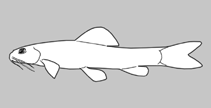
Raggi dorsali molli (totale) : 12; Raggi anali molli: 8. Differs from its congeners in Indochina by the combination of the following characters: wide median incision in upper lip; distance between anus and anal fin origin 2.6-3.8 eye diameter; pelvic fin clearly reaching beyond anus; caudal fin deeply emarginate; body with 7-11 dark bars, wider than interspaces, regularly shaped and set, meeting their homologues on back; black bar at caudal-fin base complete, reaching dorsal and ventral midlines (Ref. 40772).
Body shape (shape guide): elongated.
Abundant in streams and rivers with gravel or rocky substrate and high water velocities (Ref. 40772). Resistant to organic pollution and can survive in streams that flow through villages and towns and exhibit strong signs of human perturbation (Ref. 40772). Most abundant in riffles and rapids with current velocities more than 1 m/s below the surface (Ref. 40772). Found in small high gradient rivers and small mountain streams, as well (Ref. 40772). Often associated with Poropuntius sp., Annamia normani, Schistura dalatensis and Glyptothorax laosensis (Ref. 40772).
Ciclo vitale e comportamento di accoppiamento
Maturità | Riproduzione | Deposizione | Uova | Fecondità | Larve
Freyhof, J. and D.V. Serov, 2001. Nemacheiline loaches from Central Vietnam with descriptions of a new genus and 14 new species (Cypriniformes: Balitoridae). Ichthyol. Explor. Freshwat. 12(2):133-191. (Ref. 40772)
Stato della Lista Rossa IUCN (Ref. 130435: Version 2025-2 (Global))
Minaccia per l'uomo
Harmless
Usi umani
Strumenti
Rapporti speciali
Scarica XML
Fonti Internet
Stime basate su modelli
Indice di diversità filogenetica (Fonte Biblio.
82804): PD
50 = 0.5000 [Uniqueness, from 0.5 = low to 2.0 = high].
Bayesian length-weight: a=0.00708 (0.00323 - 0.01553), b=3.03 (2.86 - 3.20), in cm total length, based on LWR estimates for this Genus-body shape (Ref.
93245).
Livello trofico (Fonte Biblio.
69278): 3.0 ±0.3 se; based on size and trophs of closest relatives
Resilienza (Fonte Biblio.
120179): Medio, tempo minimo di raddoppiamento della popolazione 1.4 - 4.4 anni (Preliminary K or Fecundity.).
Vulnerabilità della pesca (Ref.
59153): Low vulnerability (10 of 100).
🛈