Klassifizierung / Names
Namen | Synonyme | Catalog of Fishes(Gattung, Arten) | ITIS | CoL | WoRMS | Cloffa
>
Petromyzontiformes (Lampreys) >
Petromyzontidae (Northern lampreys) > Lampetrinae
Etymology: Eudontomyzon: eu-, a Greek intensive (good, well or very); odontos (Gr.) tooth, referring to numerous radially arranged teeth of E. danfordi; myzon (Gr.), to suck (borrowed from Petromyzon), referring to their suctorial behavior (See ETYFish); stankokaramani: In honor of Karaman’s father, biologist Stanko L. Karaman (1889-1959), founder, Macedonian Museum of Natural History, “the greatest explorer of freshwater fish fauna in Yugoslavia” (See ETYFish).
Eponymy: Stanko Luka Karaman (1889–1959) was the author’s father. (See Karaman, SL) (Ref. 128868), visit book page.
Umwelt: Milieu / Klimazone / Tiefenbereich / Verbreitungsgebiet
Ökologie
; süßwasser demersal. Temperate; 41°N - 39°N, 19°E - 22°E (Ref. 59043)
Europe: Drin drainage, including Lake Ohrid and Lake Skadar basins (Albania, Kosovo, Macedonia, Montenegro).
Größe / Gewicht / Alter
Geschlechtsreife: Lm ? range ? - ? cm
Max length : 20.0 cm TL Männchen/unbestimmt; (Ref. 59403)
Kurzbeschreibung
Bestimmungsschlüssel | Morphologie | Morphometrie
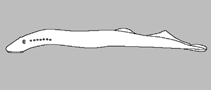
Rückenflossenstacheln (insgesamt) : 0; Rückenflossenweichstrahlen (insgesamt) : 0. With 58-65 trunk myomeres. The trunk is mottled in ammocoetes. The caudal fin is of spade-like shape and grey to black. The exolateral teeth are villiform, very small, weakly developed and frequently absent.
Body shape (shape guide): eel-like; Cross section: circular.
A non-parasitic species (Ref. 58030). Adults inhabit piedmont and montane zones in clear, well oxygenated brooks. Ammocoetes live in detritus-rich sands or clay sediments (Ref. 59043).
Lebenszyklus und Paarungsverhalten
Geschlechtsreife | Fortpflanzung | Ablaichen | Eier | Fruchtbarkeit | Larven
Probably metamorphoses in November to April in Drin dainage (Ref. 59043).
Kottelat, M. and J. Freyhof, 2007. Handbook of European freshwater fishes. Publications Kottelat, Cornol and Freyhof, Berlin. 646 pp. (Ref. 59043)
IUCN Rote Liste Status (Ref. 130435: Version 2025-2 (Global))
Bedrohung für Menschen
Harmless
Nutzung durch Menschen
Fischereien: nicht kommerziell
Tools
Zusatzinformationen
Download XML
Internet Quellen
Schätzungen auf der Grundlage von Modellen
Phylogenetischer Diversitätsindex (Ref.
82804): PD
50 = 0.5312 [Uniqueness, from 0.5 = low to 2.0 = high].
Bayesian length-weight: a=0.00132 (0.00060 - 0.00290), b=2.99 (2.80 - 3.18), in cm total length, based on LWR estimates for this (Sub)family-body shape (Ref.
93245).
Trophische Ebene (Ref.
69278): 3.6 ±0.6 se; based on size and trophs of closest relatives
Widerstandsfähigkeit (Ref.
120179): niedrig, Verdopplung der Population dauert 4,5 - 14 Jahre. (Semelparous species, assuming tm (= tmax) > 4).
Anfälligkeit der Fischerei (Ref.
59153): Low vulnerability (10 of 100).
🛈