>
Clupeiformes (Herrings) >
Engraulidae (Anchovies) > Coiliinae
Etymology: Setipinna: Latin, septem = seven + Latin, pinna, -ae = fin.
More on author: Bleeker.
Ambiente: milieu / zona climática / intervalo de profundidade / gama de distribuição
Ecologia
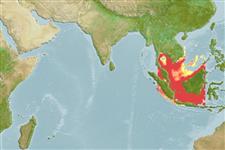
marinhas; Água doce; estuarina pelagic-neritic. Tropical; 19°N - 8°S, 99°E - 118°E (Ref. 189)
Western Central Pacific: Thailand south to Java, including rivers, e.g., the Chao Praya in Thailand and the Rokan, Kapuas and Barito in Indonesia and the Mekong River system.
Tamanho / Peso / Idade
Maturidade: Lm ? range ? - ? cm
Max length : 33.0 cm SL macho/indeterminado; (Ref. 30857); common length : 19.0 cm SL macho/indeterminado; (Ref. 9822)
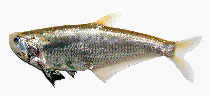
Espinhos dorsais (total) : 0; Espinhos anais: 0; Raios anais moles: 45 - 53. Belly with 21 to 26 + 8 to 10 = 30 to 35 keeled scutes from isthmus to anus. Lower gill rakers with serrae rather large, spiky, but not distinctly clumped. Pectoral filament short or even absent, never reaching even to anus. Gill cover and main part of pectoral fin often dusky or jet black; other fins pale to bright yellow (Ref. 189). Origin of anal fin in front of origin of the dorsal fin (Ref. 43281).
Body shape (shape guide): elongated; Cross section: compressed.
This species was recorded up rivers at 90, 150 and 210 km from the sea, but it is not known if these are permanent freshwater populations or migrants from the sea. At least small numbers enter artisanal river and lake fisheries (Ref. 9822). Found in large rivers far upstream from the estuary (Ref. 12693). Feeds mainly on insect larvae and small fishes. Used to make prahoc (Ref. 12693).
Ciclo de vida e comportamento de acasalamento
Maturidade | Reprodução | Desova | Ovos | Fecundidade | Larvas
Wongratana, T., T.A. Munroe and M. Nizinski, 1999. Order Clupeiformes. Engraulidae. Anchovies. p. 1698-1753. In K.E. Carpenter and V.H. Niem (eds.) FAO species identification guide for fishery purposes. The living marine resources of the WCP. Vol. 3. Batoid fishes, chimaeras and bony fishes part 1 (Elopidae to Linophrynidae). FAO, Rome. (Ref. 9822)
Categoria na Lista Vermelha da IUCN (Ref. 130435: Version 2025-2 (Global))
Ameaça para o homem
Harmless
Utilização humana
Pescarias: pescarias de subsistência
Ferramentas
Relatórios especiais
Descarregue XML
Fontes da internet
Estimativas baseadas em modelos
Temperatura preferida (Ref.
123201): 24.1 - 28.6, mean 28 °C (based on 430 cells).
Índice de diversidade filogenética (Ref.
82804): PD
50 = 0.5039 [Uniqueness, from 0.5 = low to 2.0 = high].
Bayesian length-weight: a=0.00525 (0.00303 - 0.00910), b=3.03 (2.88 - 3.18), in cm total length, based on LWR estimates for this species & (Sub)family-body (Ref.
93245).
Nível Trófico (Ref.
69278): 3.9 ±0.63 se; based on food items.
Resiliência (Ref.
120179): Médio, tempo mínimo de duplicação da população 1,4 - 4,4 anos (Preliminary K or Fecundity.).
Vulnerabilidade da pesca (Ref.
59153): Low to moderate vulnerability (30 of 100).
🛈