>
Cypriniformes (Carps) >
Cyprinidae (Minnows or carps) > Smiliogastrinae
Etymology: Enteromius: Greek, enteron = intestine + Greek, myo, mys = muscle (Ref. 45335); venustus: From the latin for pretty, and alludes to the attractive appearance of this small fish in life (Ref. 48244).
Lingkungan: lingkungan / zona iklim / kisaran kedalaman / jangkauan distribusi
Ekologi
; air tawar bentopelagis. Tropical
Africa: endemic to Pangani River drainage (Ref. 48244, Ref. 52331).
Ukuran / Berat / umur
Kematangan: Lm ? range ? - ? cm
Max length : 3.0 cm SL jantan/; (Ref. 48244)
deskripsi pendek
Kunci identifiaksi (pengenalan) | Morfologi | Morfometrik
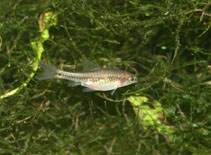
Body moderately compressed, its depth equal to or a little greater than the length of the head (Ref. 48244). Snout rounded, shorter than the eye diameter (Ref. 48244). Anterior barbel short, posterior barbel longer, extending as far as the vertical to the mid-point of the pupil of the eye (Ref. 48244). Teeth with recurved crowns; the teeth formula 2.3.5-5.3.2 (Ref. 48244). Well developed sunken pit-lines are present on the cheek and operculum and on the dorsal surface of the head; there may be as many as 12 lines between the preoperculum and the anterior orbital margin (Ref. 48244). Scales have radiate striae (Ref. 48244): 22-25 lateral line scales, 4½-5 scales between the dorsal fin origin and lateral line, 1½-2 scales between lateral line and pelvic insertion (Ref. 48244). Lateral line complete (Ref. 48244). Dorsal fin is on or slightly in advance of the perpendicular to the pelvic fin insertion; III/7 or III/8 rays, the third unbranched ray not ossified and flexible (Ref. 48244). Anal fin has III/5 rays (Ref. 48244). The pectoral fin does not reach the base of the pelvic fin (Ref. 48244). The caudal peduncle is relative slender, its depth 1.36 to 1.76 times in its length (Ref. 48244). The post Weberian vertebral count is 27 (Ref. 48244). The upper flanks, caudal peduncle and caudal fin are orange-red colored in life (Ref. 48244). A dark midlateral stripe of varying intensity runs from the tip of the snout to the base of the caudal fin; a small, rounded black spot is at the base of the caudal fin and patches of pigment about the origin of the dorsal and on the base of the anal fin (Ref. 48244).
Body shape (shape guide): fusiform / normal; Cross section: compressed.
Type specimens of Barbus venustus were caught in shallow water among open stands of the emergent grass Paspalidium geminatum in the Nyumba ya Mungu reservoir; it was taken in July and August at the onset of the dry season but with the lake level still close to its maximum (Ref. 48244). Gut content includes cladocerans, insect fragments, plant material and fine sand (Ref. 48244).
Siklus hidup dan perilaku kawin
Kematangan | Reproduksi, perkembang biakan | Pemijahan | telur-telur | Fekunditas | Larva
Bailey, R.G., 1980. A new species of small Barbus (Pisces, Cyprinidae) from Tanzania, East Africa. Bull. Br. Mus. nat. Hist. (Zool.) 38(3):141-144. (Ref. 48244)
Status IUCN Red List (Ref. 130435: Version 2025-2 (Global))
ancaman kepada manusia
Harmless
penggunaan manusia
Perikanan: tidak ada kepentingan
Alat, peralatan
laporan khas
muat turun XML
Sumber internet
Estimasi berdasarkan model
Indeks keanekaragaman filogenetik (Acuan
82804): PD
50 = 0.5000 [Uniqueness, from 0.5 = low to 2.0 = high].
Bayesian length-weight: a=0.01122 (0.00521 - 0.02417), b=3.01 (2.84 - 3.18), in cm total length, based on LWR estimates for this Genus-body shape (Ref.
93245).
Tingkat Trofik (Acuan
69278): 3.0 ±0.3 se; based on size and trophs of closest relatives
Daya lenting (Acuan
120179): Tinggi, Waktu penggandaan populasi minimum kurang dari 15 bulan (tm<1).
Kerentanan Penangkapan Ikan (Ref.
59153): Low vulnerability (10 of 100).
🛈