分类 / 名称
俗名 | 同种异名 | Catalog of Fishes(属, 种) | ITIS | CoL | WoRMS | Cloffa
Teleostei >
Blenniiformes (Blennies)
鱸形目 (Blennies) >
Blenniidae (Combtooth blennies) > Blenniinae
Etymology: Meiacanthus: Greek, meion = less = lessen + Greek, akantha = thorn (Ref. 45335).
环境:氛围 / 气候带 / 深度上下限 / 分布范围
生态学
海洋 礁区鱼类; 深度上下限 0 - 18 m (Ref. 58018). 熱帶; 30°N - 22°S
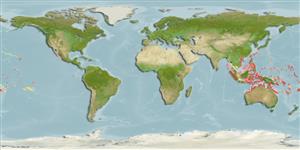
Western Pacific: Moluccas and the Philippines east to Samoa, north to Ryukyu Islands, south to Rowley Shoals in Western Australia and the northern Great Barrier Reef and Tonga; Palau (Belau) in Micronesia.
西太平洋: 模里西斯與菲律賓東至美屬薩摩亞, 北至琉球群島, 南至羅雷游入西澳大利亞與大堡礁北方與東加; 在密克羅尼西亞的帛琉 (帛琉)。
大小 / 重量 / 年龄
成熟度: Lm ? range ? - ? cm
Max length : 6.5 cm TL 雄鱼/尚未辨别雌雄; (Ref. 90102)
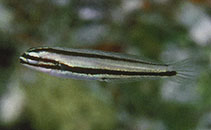
背棘 (总数) : 5 - 6; 背的软条 (总数) : 22 - 25; 臀棘: 2; 臀鳍软条: 15 - 18. Males with long filaments from the tips of the tail (Ref. 48636).
Body shape (shape guide): elongated.
雄性有来自尾巴的尖端的长的丝状突起。 (参考文献 48636)
Adults are found on reef slopes with large soft-coral communities (Ref. 48636). They form groups usually among gorgonians or black coral (Ref. 90102) in shallow protected reefs. Relatively common and broadly distributed. Feed on zooplankton. Oviparous. Eggs are demersal and adhesive (Ref. 205), and are attached to the substrate via a filamentous, adhesive pad or pedestal (Ref. 94114). Larvae are planktonic, often found in shallow, coastal waters (Ref. 94114). Minimum depth from Ref. 58018.
在礁斜坡上有大的软珊瑚群落。 (参考文献 48636) 相当普遍的而且宽广地分布了。 在水浅且有遮蔽礁区中形成鱼群并且吃浮游动物。 卵生的.(参考文献 205) 卵是底栖与聚集在一起的。 (参考文献 205)
生命周期和交配行为
成熟度 | 繁殖 | 产卵场 | 卵 | 孕卵数 | 仔鱼
Oviparous, distinct pairing (Ref. 205).西太平洋: 模里西斯與菲律賓東至美屬薩摩亞, 北至琉球群島, 南至羅雷游入西澳大利亞與大堡礁北方與東加; 在密克羅尼西亞的帛琉 (帛琉)。
Myers, R.F., 1991. Micronesian reef fishes. Second Ed. Coral Graphics, Barrigada, Guam. 298 p. (Ref. 1602)
世界自然保护联盟红皮书 (Ref. 130435: Version 2025-2 (Global))
人类利用
工具
特别资料
下载 XML
网络资源
基于模型的估算
首选温度 (参考文献
123201): 25.7 - 29.3, mean 28.5 °C (based on 1738 cells).
系统发育多样性指数 (参考文献
82804): PD
50 = 0.5000 [Uniqueness, from 0.5 = low to 2.0 = high].
Bayesian length-weight: a=0.00575 (0.00255 - 0.01297), b=3.06 (2.87 - 3.25), in cm total length, based on LWR estimates for this (Sub)family-body shape (Ref.
93245).
营养阶层 (参考文献
69278): 3.4 ±0.45 se; based on food items.
回复力 (参考文献
120179): 高度, 族群倍增时间少于 15个月 (Preliminary K or Fecundity.).
渔业脆弱性 (Ref.
59153): Low vulnerability (10 of 100).
🛈
营养素 (Ref.
124155): Calcium = 196 [100, 373] mg/100g; Iron = 1.06 [0.61, 1.83] mg/100g; Protein = 18.2 [17.0, 19.3] %; Omega3 = 0.104 [0.054, 0.196] g/100g; Selenium = 21.9 [10.2, 50.3] μg/100g; VitaminA = 226 [75, 707] μg/100g; Zinc = 2.15 [1.38, 3.19] mg/100g (wet weight);