分類 / 名前
共通名の | 類義語 | Catalog of Fishes(部類, 種) | ITIS | CoL | WoRMS | Cloffa
>
Blenniiformes (Blennies) >
Dactyloscopidae (Sand stargazers)
Etymology: Platygillellus: Greek, platys = flat + Theodore Nicolas Gill (1837-1914) researcher of abyssal fishes and systematics (Ref. 45335); brasiliensis: Named for its distribution and probably endemic in Brazil.
環境:環境 / 気候帯 / 深さの範囲 / 分布範囲
生態学
海 底生の; 深さの範囲 1 - 2 m (Ref. 56973). Tropical
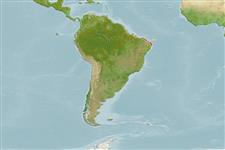
Southwest Atlantic: Brazil.
サイズ / 重さ / 年齢
成熟: Lm ? range ? - ? cm
Max length : 4.1 cm SL オス/雌雄の選別がない; (Ref. 56973); 4.0 cm SL (female)
簡単な記述
検索表 | 形態学 | 形態計測学
Diagnosis: The dorsal finlet is fan-like and 3-spined, its height more than half of predorsal length, 58-84% (vs. 4-spined in P. smithi, low profile in P. rubrocinctus); first 2 spines of finlet more closely spaced than the 2nd and 3rd. Lateral line deflection is usually located below interspace between 14th and 15th dorsal fin elements. Upper lip fimbriae more numerous than those of lower lip. Base of pectoral fin usually naked or rarely with a single scale on its upper portion (Ref. 56973).
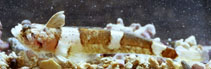
Known from shallow reefs; inhabits the margins of sand flats in small caves and below reef walls at depths of 1 to 6 meters; these areas are deposits of coarse gravel largely composed of f fragments of mollusc shells, crustaceans, corals, calcareous algae and sea urchin skeletons and spines. Found buried in the gravel, with just the eyes and the dorsal finlet exposed; it appears to 'swim' in the gravel; solitary or in groups. Associates with other sand-dwelling fishes such as Dactyloscopus tridigitatus, D. crossotus, Gillellus greyae, and toadfish Thallasophynne punctata; also an unidentified shrimp and juveniles of crabs (Callinectes sp.).
ライフサイクルと交尾行動
成熟 | 繁殖 | 放精 | 卵 | 生産力 | 幼生
Feitoza, B.M., 2002. Platygillellus brasiliensis n. sp. (Perciformes: Dactyloscopidae), the third species of the genus from the Atlantic. aqua, J. Ichthyol. Aquat. Biol. 6(1):21-28. (Ref. 56973)
IUCNのレッドリストの状況は (Ref. 130435: Version 2025-2 (Global))
人間の用途
用具
特記事項
XMLをダウンロードして下さい
インターネットの情報源
モデルに基づく推定値
好ましい温度 (参照
123201): 27 - 27.6, mean 27.5 °C (based on 44 cells).
系統多様性指数 (参照
82804): PD
50 = 0.5156 [Uniqueness, from 0.5 = low to 2.0 = high].
Bayesian length-weight: a=0.00389 (0.00180 - 0.00842), b=3.12 (2.94 - 3.30), in cm total length, based on all LWR estimates for this body shape (Ref.
93245).
栄養段階 (参照
69278): 4.0 ±0.6 se; based on size and trophs of closest relatives
漁業の脆弱性 (Ref.
59153): Low vulnerability (10 of 100).
🛈