>
Blenniiformes (Blennies) >
Chaenopsidae (Pike-, tube- and flagblennies)
Etymology: Emblemariopsis: Latin, emblema = insertion, inlaid work, raised ornament + Greek, opsis = appearance (Ref. 45335).
Eponymy: Klaus Ruetzler (d: 1936) is an Austrian-born zoologist who became an American citizen (1973) and Curator of Invertebrate Zoology at the US National Museum. [...] (Ref. 128868), visit book page.
Entorno: milieu / zona climática / rango de profundidad / gama de distribución
Ecología
marino asociado a arrecife; rango de profundidad 1 - 8 m (Ref. 125603). Tropical
Distribución
Territorios | Áreas FAO | Ecosistemas | Ocurrencias, apariciones | Mapa de puntos | Introducciones | Faunafri
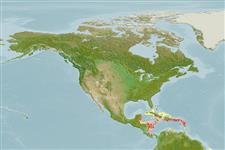
Western Central Atlantic: Belize, Honduras, south to Panama; on the islands of the western Caribbean, including San Andres and Cayman Islands; across to the northern Antilles: Mona Island, Puerto Rico, and St. Croix, St. Barthélemy, and Isla Aves, but stopping before Dominica. Apparently absent from the southern Caribbean east of Panama, i.e. Colombia, Aruba, Bonaire, Curaçao, Venezuela, Trinidad, and the Windward (southern) Lesser Antilles (Dominica, Martinique, St. Lucia, Barbados, St. Vincent and Grenadines, Grenada, and Tobago); to the north, absent from the Gulf of Mexico, Florida, the Bahamas.
Tamaño / Peso / Edad
Madurez: Lm ? range ? - ? cm
Max length : 2.0 cm SL macho / no sexado; (Ref. 51458)
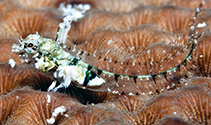
Espinas dorsales (total) : 19 - 21; Radios blandos dorsales (total) : 10 - 13; Espinas anales: 2; Radios blandos anales: 19 - 21. This species with an orbital cirrus and no red banner is distinguished by the following characters: TP territorial males found in holes with a black head; the anterior dorsal fin black, with a short, thin, white margin reaching back to second membrane; the first two membranes well incised; first dorsal-fin spine relatively short, when adpressed reaching to about 5th-6th spine base, about 1/2 HL, the third and fourth spines are also shorter, subsequent spines rising to midfin spines (Ref. 125603).
Dark-shaded and transitional TP with a relatively short first dorsal-fin spine, the second spine usually equal, with third spine about 2/3 of first, the fourth spine less than 1/2 first spine, and tenth spine about equal to first, profile of anterior dorsal fin with a moderate concavity, decreasing during transition; the first three dorsal-fin membranes white tipped, tips rounded and membranes incised; usually distinct large head spots; a prominent characteristic black spot a third way along the lower lip; without dense speckling of dorsal-fin and pectoral-fin membranes; row of dark spots along lateral midline adsent, no rows of dark spots along proximal spinous-dorsal-fin membranes, and no opercular bands or lines (Ref. 125603).
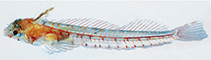
IP with elongated first two dorsal-fin spines, the first spine when adpressed reaching to base of 5th-8th spine base, the second spine about equal, the third about 2/3 of first, first two membranes with white rounded tips. Colouration: live colors greenish blue and gold; the cranial pattern of bluish spots and reticulations with a greenish gold background; IP head spots are usually reduced; melanophores near pectoral-fin base with a short oblique band to none (Ref. 125603)
Cross section: oval.
Ciclo vital y comportamiento de apareamiento
Madurez | Reproducción | Puesta | Huevos | Fecundidad | Larva
Victor, B.C., 2020. Review of the glass blennies (Teleostei: Chaenopsidae: Emblemariopsis) with two new species from the Caribbean Sea. J. Ocean Sci. Found. 37:1-122. (Ref. 125603)
Situación en la Lista Roja de la UICN (Ref. 130435: Version 2025-2 (Global))
Amenaza para el ser humano
Harmless
Usos humanos
Herramientas
Informes especiales
Descargar XML
Fuentes de Internet
Estimaciones basadas en modelos
Temperatura preferida (Referencia
123201): 27.3 - 28.2, mean 27.8 °C (based on 156 cells).
Índice de diversidad filogenética (Referencia
82804): PD
50 = 0.5001 [Uniqueness, from 0.5 = low to 2.0 = high].
Bayesian length-weight: a=0.00525 (0.00224 - 0.01232), b=3.07 (2.86 - 3.28), in cm total length, based on LWR estimates for this (Sub)family-body shape (Ref.
93245).
Nivel trófico (Referencia
69278): 3.1 ±0.4 se; based on size and trophs of closest relatives
Vulnerabilidad pesquera (Ref.
59153): Low vulnerability (10 of 100).
🛈