>
Blenniiformes (Blennies) >
Chaenopsidae (Pike-, tube- and flagblennies)
Etymology: Acanthemblemaria: Greek, akantha = thorn + Greek, emblema, -atos, anything that is nailed, knocked in; also anything with bass or high relief (Ref. 45335); atrata: Name from Latin meaning 'dressed in black', referring to its unique dark color morhp (Ref. 81029).
Environnement : milieu / zone climatique / profondeur / gamme de distribution
Écologie
marin démersal; profondeur 5 - 31 m (Ref. 81029). Tropical
Eastern Central Pacific: Cocos Island (Costa Rica).
Taille / Poids / Âge
Maturité: Lm ? range ? - ? cm
Max length : 3.2 cm SL mâle / non sexé; (Ref. 81029); 3.2 cm SL (female)
Description synthétique
Clés d'identification | Morphologie | Morphométrie
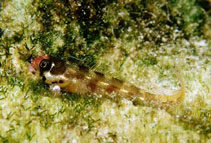
Épines dorsales (Total) : 22 - 25; Rayons mous dorsaux (Total) : 11 - 14; Épines anales: 2; Rayons mous anaux: 23 - 26; Vertèbres: 40 - 43. This species is distinguished by the following characters: 1-2 pairs of large iridescent blue spots on the upper lip; relatively small body size; 2 common pores (sensory pores between the mandibular and preopercular series); a closed wedge of spines on the posterior part of the frontal; 2 rows of interorbital spines, the outer one continuous; D XXII-XXV,11-14 (35-37 total dorsal-fin elements; A II,23-26 (Ref. 81029).
Body shape (shape guide): elongated.
A small benthic reef fish which is common in shallow water, but also occurs to depths of at least 31 meters (Ref. 81029). Oviparous (Ref. 56066). Eggs are attached to the walls of the parent's shelter and are brooded by the male parent (Ref. 56066).
Cycle de vie et comportement reproducteur
Maturité | Reproduction | Frai | Œufs | Fécondité | Larves
Oviparous (Ref. 56066). Males guard the eggs until they hatch (Ref. 56065). Also Ref. 101194.
Hastings, P.A. and D.R. Robertson, 1999. Acanthemblemaria atrata and Acanthemblemaria mangognatha, new species of eastern Pacific barnacle blennies (Chaenopsidae) from Isla de Coco, Costa Rica, and Islas Revillagigedo, Mexico, and their relationships with other barnacle blennies. Rev. Fr. Aquariol. 25(3-4):107-118. (Ref. 81029)
Statut dans la liste rouge de l'IUCN (Ref. 130435: Version 2025-2 (Global))
Menace pour l'homme
Harmless
Utilisations par l'homme
Outils
Articles particuliers
Télécharger en XML
Sources Internet
Estimations basées sur des modèles
Indice de diversité phylogénétique (Réf.
82804): PD
50 = 0.5000 [Uniqueness, from 0.5 = low to 2.0 = high].
Bayesian length-weight: a=0.00525 (0.00224 - 0.01232), b=3.07 (2.86 - 3.28), in cm total length, based on LWR estimates for this (Sub)family-body shape (Ref.
93245).
Niveau trophique (Réf.
69278): 3.2 ±0.4 se; based on size and trophs of closest relatives
Vulnérabilité de la pêche (Ref.
59153): Low vulnerability (10 of 100).
🛈