Entorno: milieu / zona climática / rango de profundidad / gama de distribución
Ecología
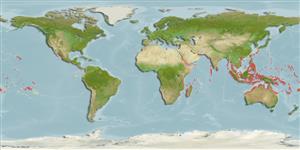
marino asociado a arrecife; rango de profundidad 0 - 3 m (Ref. 30874). Tropical; 32°N - 28°S
Indo-Pacific: Laccadive Islands and Maldives to Mangaréva, Gambier Islands. Western Central Pacific: Guam (Ref. 35721).
Tamaño / Peso / Edad
Madurez: Lm ? range ? - ? cm
Max length : 15.0 cm TL macho / no sexado; (Ref. 48636)
Descripción breve
Claves de identificación | Morfología | Morfometría
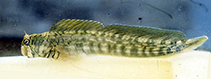
Espinas dorsales (total) : 13 - 14; Radios blandos dorsales (total) : 22 - 25; Espinas anales: 2; Radios blandos anales: 23 - 25. Color dusky, greenish with dusky lines. Males with crest and dorsal with alternate dark and pale oblique lines (Ref. 48636). Living specimens may exhibit a complex facial pattern similar to, but not quite as intricate as, that of Entomacrodus niuafoouensis, and barely discernable parallel pinstripes on their sides.
Body shape (shape guide): elongated.
Facultative air-breathing (Ref. 126274); Adults occur in the intertidal zone of rocky shores, rocky reef flats (Ref. 9710), including rock pools, harbors and mangrove zones (Ref. 48636). They graze algae on rocks by groups (Ref. 90102). Oviparous. Eggs are demersal and adhesive (Ref. 205), and are attached to the substrate via a filamentous, adhesive pad or pedestal (Ref. 94114). Larvae are planktonic, often found in shallow, coastal waters (Ref. 94114).
Ciclo vital y comportamiento de apareamiento
Madurez | Reproducción | Puesta | Huevos | Fecundidad | Larva
Oviparous, distinct pairing (Ref. 205).
Springer, V.G. and J.T. Williams, 1994. The Indo-West Pacific blenniid fish genus Istiblennius reappraised: a revision of Istiblennius, Blenniella, and Paralticus, new genus. Smithson. Contrib. Zool. 565:1-193. (Ref. 9962)
Situación en la Lista Roja de la UICN (Ref. 130435: Version 2025-2 (Global))
Amenaza para el ser humano
Harmless
Usos humanos
Pesquerías: sin interés; Acuario: Comercial
Herramientas
Informes especiales
Descargar XML
Fuentes de Internet
Estimaciones basadas en modelos
Temperatura preferida (Referencia
123201): 25.2 - 29.3, mean 28.5 °C (based on 2835 cells).
Índice de diversidad filogenética (Referencia
82804): PD
50 = 0.5001 [Uniqueness, from 0.5 = low to 2.0 = high].
Bayesian length-weight: a=0.00776 (0.00354 - 0.01702), b=3.00 (2.81 - 3.19), in cm total length, based on LWR estimates for this (Sub)family-body shape (Ref.
93245).
Nivel trófico (Referencia
69278): 2.0 ±0.00 se; based on food items.
Resiliencia (Referencia
120179): Alto, población duplicada en un tiempo mínimo inferior a 15 meses (Preliminary K or Fecundity.).
Vulnerabilidad pesquera (Ref.
59153): Low vulnerability (10 of 100).
🛈
Nutrientes (Ref.
124155): Calcium = 128 [62, 228] mg/100g; Iron = 0.763 [0.417, 1.358] mg/100g; Protein = 18 [17, 19] %; Omega3 = 0.0659 [, ] g/100g; Selenium = 18.1 [8.4, 42.4] μg/100g; VitaminA = 104 [24, 439] μg/100g; Zinc = 2.41 [1.55, 3.58] mg/100g (wet weight);