Classificazione / Nomi
Nomi Comuni | Sinonimi | Catalog of Fishes(Genere, Specie) | ITIS | CoL | WoRMS | Cloffa
>
Characiformes (Characins) >
Lebiasinidae (Pencilfishes) > Lebiasininae
Etymology: hoffmannorum: Named for Peter Hoffmann.
Eponymy: Dr Patrick Henri de Rham (d: 1936) is a Swiss zoologist, botanist, ichthyologist and aquarist in Lausanne, and was Expert Ecologist to the Coopération Technique Suisse. He is a Director of the Aquatic Conservation Network. (Also see Patrick and Rham) Peter Hoffmann of Salzgitter, Germany and Dr Martin Hoffmann of Hanover, Germany, collected the type specimens and, according to the etymology, it was they: “ …who managed to collect and acclimate the species and gave us precious information about [...] (Ref. 128868), visit book page.
More on authors: Géry & Zarske.
Ambiente: milieu / zona climatica / distribuzione batimetrica / gamma di distribuzione
Ecologia
; acqua dolce pelagico. Tropical
South America: Mazaruni River, Guyana.
Dimensione / Peso / Età
Maturità: Lm ? range ? - ? cm
Max length : 6.1 cm SL maschio/sesso non determinato; (Ref. 47610)
Breve descrizione
Chiavi di identificazione | Morfologia | Morfometria
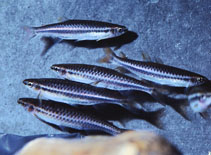
Spine dorsali (totale) : 2; Raggi dorsali molli (totale) : 8; Raggi anali molli: 9 - 10. Elongated body (greatest depth 4.60-5.45 in SL) with a narrow caudal peduncle; symmetrical caudal fin and a dorsal fin far backward. Transverse scales from dorsal to pelvic, 6 or 6.5; predorsal scales 15.5 or 16. Mouth somewhat superior with a short maxilla (apparent length 4.5-5.5 in HL), not quite reaching the level of the eye's front margin. Eyes relatively large. A longitudinal black band surmounted by a light line, from opercle to base of middle caudal rays (Ref. 47610).
Body shape (shape guide): elongated; Cross section: compressed.
A shy species (probably the most timorous pencil-fish species), living mainly on the surface and hidden, when possible, under a floating leaf or other hiding possibility. Swims actively, in a fitful manner, the moving of the pectorals is alternative, not symmetric. In captivity, accepts all foods, including dry ones, but only on the surface, neglecting what falls on the bottom. No peculiar nocturnal coloration; no direct courtship was yet observed, only short hunts against each other (within and between sexes) without real fights (Ref. 47610).
Ciclo vitale e comportamento di accoppiamento
Maturità | Riproduzione | Deposizione | Uova | Fecondità | Larve
Géry, J. and A. Zarske, 2002. Derhamia hoffmannorum gen. et sp. n. - a new pencil fish (Teleostei, Characiformes, Lebiasinidae), endemic from the Mazaruni River in Guyana. Zool. Abh., Staat. Mus. Tierk. Dresden (52):35-47. (Ref. 47610)
Stato della Lista Rossa IUCN (Ref. 130435: Version 2025-2 (Global))
Minaccia per l'uomo
Harmless
Usi umani
Strumenti
Rapporti speciali
Scarica XML
Fonti Internet
Stime basate su modelli
Indice di diversità filogenetica (Fonte Biblio.
82804): PD
50 = 1.0000 [Uniqueness, from 0.5 = low to 2.0 = high].
Bayesian length-weight: a=0.00692 (0.00276 - 0.01737), b=3.05 (2.83 - 3.27), in cm total length, based on LWR estimates for this (Sub)family-body shape (Ref.
93245).
Livello trofico (Fonte Biblio.
69278): 3.4 ±0.4 se; based on size and trophs of closest relatives
Vulnerabilità della pesca (Ref.
59153): Low vulnerability (10 of 100).
🛈