>
Cypriniformes (Carps) >
Balitoridae (River loaches)
Etymology: Sinogastromyzon: Latin, sino, sina = from China + Greek, gaster = stomach + Greek, myzo = to suckle (Ref. 45335); nantaiensis: Named derived from the Chinese name of the type locality 'Nan-Tai' which means southern Taiwan.
Meio ambiente: milieu / Zona climática / intervalo de profundidade / faixa de distribuição
Ecologia
; Água doce demersal. Subtropical
Asia: Kaoping and Tzengwen River basins (including Chiaryi, Tainan, Kaohsiung and Pingtung counties) in southern Taiwan.
Tamanho / Peso / Idade
Maturidade: Lm ? range ? - ? cm
Max length : 4.5 cm SL macho/indeterminado; (Ref. 47271)
Descrição suscinta
Chaves de identificação | Morfologia | Morfometria
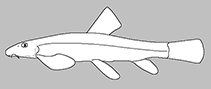
Espinhos dorsais (total) : 0; Raios dorsais (total) : 11 - 12; Espinhos anais: 0; Raios anais : 7; Vértebras: 32. Pectoral fin with modally 11 simple and 14 branched rays; pelvic fin with modally 7 simple and 16 branched rays; predorsal scales 16-17; body uniformly olive brown; predorsal region of dorsum uniform in adults, with dark brown blotches in smaller sub-adults; pectoral fin base unmarked; caudal fin with 3 vertical dark bars. Pectoral fin quite large, length longer than head length; pelvic fin entirely fused posteriorly; lower lobe of caudal fin slightly longer than upper one (Ref. 47271).
Body shape (shape guide): elongated.
Occurs in the middle reaches of streams with swift current over a substrate of gravel. Is always found in riffles at altitudes below 500 m (Ref. 47271).
Ciclo de vida ou comportamento de acasalamento
Maturidade | Reprodução | Desova | Ovos | Fecundidade | Larvas
Chen, I.-S., C.-C. Han and L.-S. Fang, 2002. Sinogastromyzon nantaiensis, a new balitorid fish from southern Taiwan (Teleostei: Balitoridae). Ichthyol. Explor. Freshwat. 13(3):239-242. (Ref. 47271)
Status na Lista Vermelha da UICN (Ref. 130435: Version 2025-2 (Global))
Ameaça para os humanos
Harmless
Uso pelos humanos
Ferramentas
Relatórios especiais
Baixar XML
Fontes da internet
Estimativas baseadas em modelos
Índice de diversidade filogenética (Ref.
82804): PD
50 = 0.5000 [Uniqueness, from 0.5 = low to 2.0 = high].
Bayesian length-weight: a=0.00724 (0.00319 - 0.01647), b=3.06 (2.87 - 3.25), in cm total length, based on LWR estimates for this (Sub)family-body shape (Ref.
93245).
Nível Trófico (Ref.
69278): 3.1 ±0.4 se; based on size and trophs of closest relatives
Vulnerabilidade da pesca (Ref.
59153): Low vulnerability (10 of 100).
🛈