Classificatie / Namen
Lokale namen | Synoniemen | Catalog of Fishes(Genus, Soort(en)) | ITIS | CoL | WoRMS | Cloffa
>
Siluriformes (Catfishes) >
Claroteidae (Claroteid catfishes)
Etymology: Chrysichthys: Greek, chrysos = golden + Greek, ichthys = fish (Ref. 45335); polli: Named after Dr. M. Poll, a well-known ichthyologist (Ref. 47263).
Eponymy: Dr Max Fernand Leon Poll (1908–1991) was a Belgian ichthyologist, and ‘connoisseur of the fish fauna’. [...] (Ref. 128868), visit book page.
Milieu: milieu / Klimaatzone / Diepte / verspreidingsgebied
Ecologie
; zoet water demersaal. Tropical
Africa: lower Congo River basin (Ref. 47263). Also reported from the Ubangi drainage (middle Congo River basin) (Ref. 78218).
Lengte bij maturiteit / Grootte / Gewicht / Leeftijd
Maturiteit: Lm 7.5, range 7 - 8 cm
Max length : 11.2 cm SL mannelijk / geslacht onbekend; (Ref. 47263)
Korte beschrijving
Determinatiesleutels | Morfologie | Morfometrie
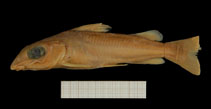
Dorsale stekels (totaal) : 1; Dorsale zachte stralen (totaal) : 6; Anale zachte stralen: 12 - 14. Body moderately elongate (Ref. 47263). A deep head, its height more than 66% of the head length (Ref. 47263). An obtusely pointed snout, slightly rounded (Ref. 47263). Eye-diameter longer than the length of the nasal barbel (Ref. 47263). Nasal barbel short, hardly reaching the anterior edge of the orbit; maxillary barbel moderate reaching the tip of the humeral spine; outer mandibulary barbel moderate, up to the posterior end of the operculum; inner mandibulary barbel reaching the end of the orbit; the two pairs of slender mandibulary barbels are distantly set and in between small papillae are found (Ref. 47263). A low number, 13-14, of slender gill rakers (Ref. 47263). Humeral spine well developed, but not reaching beyond the level of the dorsal spine (Ref. 47263). Dorsal spine short, strongly serrated on the posterior side; pectoral spine well developed, strongly serrated on the inner side (Ref. 47263). Dorsal fin short, much shorter than the head length; pectoral fin short, not reaching the base of the ventral fin; anal fin moderate, its base longer than or equal to the base of the adipose fin (Ref. 47263). Adipose fin small, the length of its base shorter than the length of the base of the dorsal fin (Ref. 47263). Preserved specimens are dark brown above the lateral line and lighter beneath; sometimes there is a black band behind the operculum (Ref. 47263). The dorsal and caudal fin may show a tiny black margin (Ref. 47263).
Body shape (shape guide): elongated.
Levenscyclus en paargedrag
Maturiteit | Voortplanting | Paaien | Eieren | Fecunditeit | Larven
Risch, L., 1987. Description of four new bagrid catfishes from Africa (Siluriformes: Bagridae). Cybium 11(1):21-38. (Ref. 47263)
Status op de Rode Lijst van het IUCN (Ref. 130435: Version 2025-2 (Global))
Gevaar voor de mens
Harmless
Gebruik door de mens
Tools
Speciale rapporten
Download XML
Internetbronnen
Schattingen op basis van modellen
Fylogenetische diversiteitsindex (Ref.
82804): PD
50 = 0.5000 [Uniqueness, from 0.5 = low to 2.0 = high].
Bayesian length-weight: a=0.01047 (0.00458 - 0.02392), b=2.98 (2.80 - 3.16), in cm total length, based on LWR estimates for this Genus-body shape (Ref.
93245).
Trofisch niveau (Ref.
69278): 3.2 ±0.4 se; based on size and trophs of closest relatives
Weerstandsvermogen (Ref.
120179): Hoog, minimale populatieverdubbelingstijd minder dan 15 maanden (Preliminary K or Fecundity.).
Kwetsbaarheid van de visserij (Ref.
59153): Low vulnerability (10 of 100).
🛈