>
Kurtiformes (Nurseryfishes, cardinalfishes.) >
Apogonidae (Cardinalfishes) > Apogoninae
Etymology: Archamia: Greek, arche = old + Greek, amia = a kind of fish (Ref. 45335).
Eponymy: Dr Ofer Gon (d: 1949) is a South African ichthyologist who is Senior Aquatic Biologist at the JLB Institute of Ichthyology. [...] (Ref. 128868), visit book page.
More on author: Günther.
Umwelt: Milieu / Klimazone / Tiefenbereich / Verbreitungsgebiet
Ökologie
seewasser riff-verbunden; tiefenbereich 10 - 30 m (Ref. 90102). Tropical
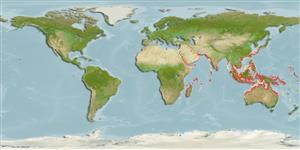
Indo-West Pacific: east coast of Africa south to Durban, and eastward to the Gulf of Oman, India, Sri Lanka, Thailand, Singapore, Indonesia, Taiwan, and Queensland.
Größe / Gewicht / Alter
Geschlechtsreife: Lm ? range ? - ? cm
Max length : 12.6 cm TL Männchen/unbestimmt; (Ref. 125969); max. veröff. Gewicht: 23.20 g (Ref. 125969)
Rückenflossenstacheln (insgesamt) : 8; Rückenflossenweichstrahlen (insgesamt) : 9; Afterflossenstacheln: 2; Afterflossenweichstrahlen: 15 - 17. Color in life silver gray, translucent on body, variable amount of bright yellow pigment on head and body, most commonly on snout, jaws and throat; side of snout sometimes with dark dots; black caudal spot pupil size or smaller; fins pale; diffuse orange stripe above anal-fin base. Rays: dorsal rays VII,9; anal II,15-17 (usually 16); pectoral 14 (rarely 13 or 15). Lateral line scales 25 + 3-4; median predorsal scales 5-6 (rarely 5). Gill rakers 5-7 + 15-18. Body depth 2.6-3.2 in SL; body width 2.2-2.8 in depth; eye diameter 2.7-4.4 in HL; first dorsal spine 1.1-1.4 in second spine; second dorsal spine 2.2-3.0; third dorsal spine 2.3-3.0 in HL; spine of second dorsal fin 2.6-3.1, and second anal spine 3.4-4.5 in HL; pelvic-fin length 4.5-5.8, and caudal-peduncle length 4.5-5.4 in SL. Distance from insertion of pelvic spine to anal-fin origin 4.5-5.7 in SL. Preopercular edge smooth except for serrae at angle and on posterior half of ventral edge. Scaly sheath along anal-fin base poorly developed.
Body shape (shape guide): short and / or deep; Cross section: compressed.
Found in coastal, mangrove zones and thought to enter rivers, but also found with shipwrecks in deeper water laying on muddy substrates (Ref. 48635); also on reefs, over sandy and muddy bottoms in silty conditions (Ref. 54391) Forms aggregations that hover above rocky outcrops (Ref 90102). Feeds on fish eggs and larvae, shrimps, and pelagic polychaetes (Ref. 31551).
Lebenszyklus und Paarungsverhalten
Geschlechtsreife | Fortpflanzung | Ablaichen | Eier | Fruchtbarkeit | Larven
Are mouthbrooders (Ref. 240). Distinct pairing during courtship and spawning (Ref. 205).
Gon, O. and J.E. Randall, 2003. Revision of the Indo-Pacific cardinalfish genus Archamia (Perciformes: Apogonidae), with description of a new species. Indo-Pac. Fish. (35):49 p. (Ref. 54391)
IUCN Rote Liste Status (Ref. 130435: Version 2025-2 (Global))
Bedrohung für Menschen
Harmless
Nutzung durch Menschen
Tools
Zusatzinformationen
Download XML
Internet Quellen
Schätzungen auf der Grundlage von Modellen
Bevorzugte Temperatur (Ref.
123201): 25.1 - 29.1, mean 28.2 °C (based on 620 cells).
Phylogenetischer Diversitätsindex (Ref.
82804): PD
50 = 1.0000 [Uniqueness, from 0.5 = low to 2.0 = high].
Bayesian length-weight: a=0.01000 (0.00598 - 0.01673), b=2.94 (2.80 - 3.08), in cm total length, based on LWR estimates for this species & (Sub)family-body (Ref.
93245).
Trophische Ebene (Ref.
69278): 3.7 ±0.51 se; based on food items.
Widerstandsfähigkeit (Ref.
120179): hoch, Verdopplung der Population dauert weniger als 15 Monate. (Preliminary K or Fecundity.).
Anfälligkeit der Fischerei (Ref.
59153): Low vulnerability (10 of 100).
🛈
Nährstoffe (Ref.
124155): Calcium = 146 [72, 253] mg/100g; Iron = 1.11 [0.63, 1.95] mg/100g; Protein = 18.5 [17.3, 19.7] %; Omega3 = 0.129 [0.069, 0.235] g/100g; Selenium = 30.3 [14.7, 62.9] μg/100g; VitaminA = 90.9 [28.3, 308.7] μg/100g; Zinc = 1.57 [1.00, 2.33] mg/100g (wet weight);