Entorno: milieu / zona climática / rango de profundidad / gama de distribución
Ecología
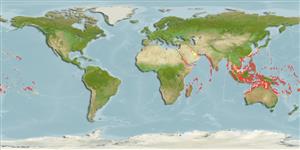
marino asociado a arrecife; rango de profundidad 0 - 60 m (Ref. 128797). Tropical; 35°N - 26°S, 32°E - 122°W
Indo-Pacific: Red Sea, East Africa eastward through northern Australia reaching to Line and Tuamotu islands, north to southern Japan.
Tamaño / Peso / Edad
Madurez: Lm ? range ? - ? cm
Max length : 75.0 cm TL macho / no sexado; (Ref. 9710)
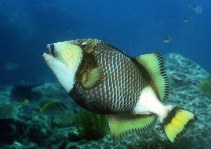
Espinas dorsales (total) : 3; Radios blandos dorsales (total) : 24 - 26; Espinas anales: 0; Radios blandos anales: 22 - 24. Fish has a deep grove before eye; scaleless area around lips, continuing and narrowing posterior to corner of mouth; small forward-curving spines in about five rows on side of and a short distance anterior to caudal peduncle. Caudal peduncle compressed (Ref. 9770).
Body shape (shape guide): short and / or deep; Cross section: oval.
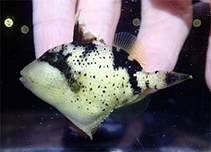
Recorded from lagoons, seaward reefs (Ref. 1602) and sheltered inner reef slopes (Ref. 48637). Juveniles often associated with isolated patches of branching coral or rubble of shallow sandy protected areas. Adults occur singly or in pairs on the slopes of deep lagoon or seaward reefs (Ref. 37816, 48637). Often hostile towards divers and may attack unprovoked when caring for eggs (Ref. 48637). Feed on sea urchins, coral, crabs and other crustaceans, mollusks and tube worms. Oviparous (Ref. 205). Largest triggerfish; females are reported to have attacked divers when guarding their nest (Ref. 2334). Also caught with drive-in nets. Marketed fresh and dried-salted (Ref. 9770).
Ciclo vital y comportamiento de apareamiento
Madurez | Reproducción | Puesta | Huevos | Fecundidad | Larva
Distinct paring (Ref. 205).
Matsuura, K., 2001. Balistidae. Triggerfishes. p. 3911-3928. In K.E. Carpenter and V. Niem (eds.) FAO species identification guide for fishery purposes. The living marine resources of the Western Central Pacific. Vol. 6. Bony fishes part 4 (Labridae to Latimeriidae), estuarine crocodiles. FAO, Rome. (Ref. 9770)
Situación en la Lista Roja de la UICN (Ref. 130435: Version 2025-2 (Global))
Amenaza para el ser humano
Reports of ciguatera poisoning (Ref. 1602)
Usos humanos
Pesquerías: comercial
Herramientas
Informes especiales
Descargar XML
Fuentes de Internet
Estimaciones basadas en modelos
Temperatura preferida (Referencia
123201): 25 - 29, mean 28.1 °C (based on 1016 cells).
Índice de diversidad filogenética (Referencia
82804): PD
50 = 0.7500 [Uniqueness, from 0.5 = low to 2.0 = high].
Bayesian length-weight: a=0.03631 (0.02362 - 0.05582), b=2.93 (2.81 - 3.05), in cm total length, based on LWR estimates for this species & (Sub)family-body (Ref.
93245).
Nivel trófico (Referencia
69278): 3.3 ±0.44 se; based on food items.
Resiliencia (Referencia
120179): Bajo, población duplicada en un tiempo mínimo de 4.5-14 años (Preliminary K or Fecundity.).
Vulnerabilidad pesquera (Ref.
59153): Moderate to high vulnerability (50 of 100).
🛈
Nutrientes (Ref.
124155): Calcium = 25.1 [10.4, 57.0] mg/100g; Iron = 0.488 [0.251, 1.074] mg/100g; Protein = 18.5 [16.3, 20.6] %; Omega3 = 0.0968 [, ] g/100g; Selenium = 43.1 [20.9, 90.5] μg/100g; VitaminA = 37.9 [10.7, 136.5] μg/100g; Zinc = 0.888 [0.604, 1.321] mg/100g (wet weight);