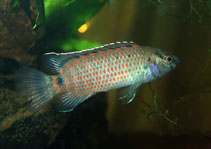
>
Anabantiformes (Gouramies, snakeheads) >
Badidae (Chameleonfishes)
Etymology: Badis: 'badis' is presumably a Bengali local name, possibly derived from 'bhedo' or 'bheda', but it lacks a proper reference. Probably incorrect etymology (J. Müller, pers. comm., April 2021, after information from native speakers); khwae: Named after its type locality, Mae Nam Khwae Noi.
More on authors: Kullander & Britz.
Meio ambiente: milieu / Zona climática / intervalo de profundidade / faixa de distribuição
Ecologia
; Água doce bentopelágico; intervalo de profundidade 0 - 2 m (Ref. 46238). Tropical
Asia: Thailand.
Tamanho / Peso / Idade
Maturidade: Lm ? range ? - ? cm
Max length : 2.9 cm SL macho/indeterminado; (Ref. 46238)
Espinhos dorsais (total) : 16 - 17; Raios dorsais (total) : 8 - 10; Raios anais : 7 - 8; Vértebras: 27 - 28. Possesses a dark blotch on the dorsolateral aspect of the caudal peduncle present. Postorbital stripe angled. Rounded caudal fin; blotch on caudal peduncle small and confined to the side of the caudal peduncle. Absence of a pattern of horizontal rows alternating light and dark stripes along side and absence of prominent dark spots in vertical bars or horizontal rows. Dark bar entirely across the caudal fin base with the dorsalmost portion darker and separated from the rest by light band instead of the 3 dark blotches in most Badis species. Scales in lateral row 27-28 (Ref. 46238).
Body shape (shape guide): fusiform / normal; Cross section: compressed.
The type locality was a small creek, 1-2 m wide, 0.1-0.3 m deep; sandy bottom with some aquatic vegetation, in a cultivated area; located in a deep groove, covered by trees. Also collected from a relatively large stream and from a spring fed reservoir, up to 2 m deep (Ref. 46238).
Ciclo de vida ou comportamento de acasalamento
Maturidade | Reprodução | Desova | Ovos | Fecundidade | Larvas
Kullander, S.O. and R. Britz, 2002. Revision of the family Badidae (Teleostei: Perciformes), with description of a new genus and ten new species. Ichthyol. Explor. Freshwat. 13(4):295-372. (Ref. 46238)
Status na Lista Vermelha da UICN (Ref. 130435: Version 2025-2 (Global))
Ameaça para os humanos
Harmless
Uso pelos humanos
Pescarias: sem interesse
Ferramentas
Relatórios especiais
Baixar XML
Fontes da internet
Estimativas baseadas em modelos
Índice de diversidade filogenética (Ref.
82804): PD
50 = 0.5000 [Uniqueness, from 0.5 = low to 2.0 = high].
Bayesian length-weight: a=0.01175 (0.00503 - 0.02745), b=2.93 (2.73 - 3.13), in cm total length, based on LWR estimates for this (Sub)family-body shape (Ref.
93245).
Nível Trófico (Ref.
69278): 3.1 ±0.4 se; based on size and trophs of closest relatives
Resiliência (Ref.
120179): Baixo, tempo mínimo de duplicação da população 4,5 - 14 anos (Assuming Fec<100).
Vulnerabilidade da pesca (Ref.
59153): Low vulnerability (10 of 100).
🛈