Entorno: milieu / zona climática / rango de profundidad / gama de distribución
Ecología
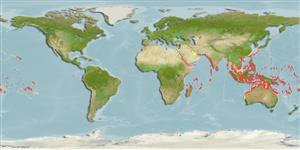
marino asociado a arrecife; rango de profundidad 0 - 60 m (Ref. 128797). Tropical; 32°N - 32°S, 30°E - 132°W
Indo-Pacific: Red Sea south to Natal, South Africa (Ref. 4420) and east to the Line, Marquesan and Tuamoto islands, north to southern Japan, south to the southern Great Barrier Reef and New Caledonia.
Longitud en la primera madurez / Tamaño / Peso / Edad
Madurez: Lm 15.7, range 8 - ? cm
Max length : 30.0 cm TL macho / no sexado; (Ref. 2334); common length : 26.0 cm TL macho / no sexado; (Ref. 5450)
Descripción breve
Claves de identificación | Morfología | Morfometría
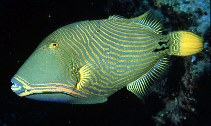
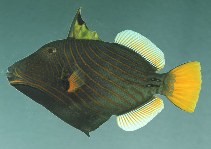
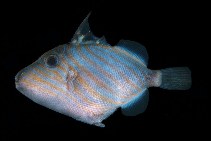
Espinas dorsales (total) : 3; Radios blandos dorsales (total) : 24 - 27; Espinas anales: 0; Radios blandos anales: 20 - 24. This species is distinguished by the following characters: front of eye without the elongate groove; enlarged scales above the pectoral-fin base and just behind the gill opening to form a flexible tympanum; the scales of the caudal peduncle with 2 longitudinal rows of large anterior-projecting spines; the slightly rounded caudal fin with compressed peduncle; head and body colour green to brown with diagonally curved orange lines and a large round black blotch covering most of the caudal-fin base; rays of soft dorsal, anal and pectoral fins orange and also the caudal fin (Ref. 10920, 9770).
Body shape (shape guide): short and / or deep; Cross section: oval.
Adults which are territorial in nature occur in coral-rich areas of deep lagoon and seaward reefs from the lower surge zone to at least 50 meters (Ref. 48637). They feed on a variety of benthic organisms such as algae, echinoderms, fishes, mollusks, tunicates, sponges, and hydrozoans. Eggs are laid as one cluster in a shallow excavation on sand or rubble along channels. (Ref. 1602). Marketed fresh and dried-salted (Ref. 9770).
Spawning behaviour may involve loose aggregations and nesting occurs in channels. The eggs are laid in a single spongy cluster in a shallow excavation in rubble or sand. Hatching occurs at night (Ref. 37816). Nests are guarded by one or at times two adults (Ref. 9778).
Matsuura, K., 2001. Balistidae. Triggerfishes. p. 3911-3928. In K.E. Carpenter and V. Niem (eds.) FAO species identification guide for fishery purposes. The living marine resources of the Western Central Pacific. Vol. 6. Bony fishes part 4 (Labridae to Latimeriidae), estuarine crocodiles. FAO, Rome. (Ref. 9770)
Situación en la Lista Roja de la UICN (Ref. 130435: Version 2025-2 (Global))
Amenaza para el ser humano
Traumatogenic (Ref. 4420)
Usos humanos
Pesquerías: comercial; Acuario: Comercial
Herramientas
Informes especiales
Descargar XML
Fuentes de Internet
Estimaciones basadas en modelos
Temperatura preferida (Referencia
123201): 25.1 - 29.1, mean 28 °C (based on 1034 cells).
Índice de diversidad filogenética (Referencia
82804): PD
50 = 1.0000 [Uniqueness, from 0.5 = low to 2.0 = high].
Bayesian length-weight: a=0.02951 (0.02404 - 0.03622), b=2.93 (2.87 - 2.99), in cm total length, based on LWR estimates for this species (Ref.
93245).
Nivel trófico (Referencia
69278): 3.4 ±0.42 se; based on food items.
Resiliencia (Referencia
120179): Medio, población duplicada en un tiempo mínimo de 1.4-4.4 años (Preliminary K or Fecundity.).
Vulnerabilidad pesquera (Ref.
59153): Low vulnerability (20 of 100).
🛈
Nutrientes (Ref.
124155): Calcium = 45.5 [19.1, 112.8] mg/100g; Iron = 0.609 [0.316, 1.378] mg/100g; Protein = 18.4 [16.3, 20.5] %; Omega3 = 0.118 [0.060, 0.227] g/100g; Selenium = 34.2 [17.9, 70.8] μg/100g; VitaminA = 56.4 [16.5, 196.9] μg/100g; Zinc = 1.07 [0.73, 1.59] mg/100g (wet weight);