>
Eupercaria/misc (Various families in series Eupercaria) >
Haemulidae (Grunts) > Haemulinae
Etymology: Pomadasys: Greek, poma, -atos = cover, operculum + Greek, dasys = with hair (Ref. 45335).
More on author: Cuvier.
Milieu: milieu / Klimaatzone / Diepte / verspreidingsgebied
Ecologie
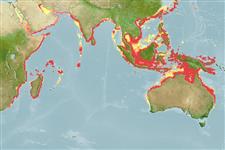
marien; brak water rifbewoner; diepte ? - 75 m (Ref. 2799). Tropical; 32°N - 32°S, 18°E - 154°E
Indo-West Pacific: Red Sea and east coast of Africa to southeast Asia, north to Taiwan, south to Queensland, Australia. Also reported from Persian Gulf (Ref. 68964).
Lengte bij maturiteit / Grootte / Gewicht / Leeftijd
Maturiteit: Lm ?, range 35 - ? cm
Max length : 80.0 cm TL mannelijk / geslacht onbekend; (Ref. 5213); common length : 50.0 cm TL mannelijk / geslacht onbekend; (Ref. 30573)
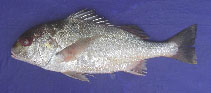
Dorsale stekels (totaal) : 12; Dorsale zachte stralen (totaal) : 13 - 15; Anale stekels: 3; Anale zachte stralen: 7. This species is distinguished by the following characters: chin with 2 pores with a median pit; D XII,13-15 (usually 14 ½); A III,7; scales ctenoid (rough to touch); lateral line scales 43-50; scales between lateral line and dorsal-fin origin 7; scales around caudal peduncle 20, 9 above lateral line and 9 below; body depth 2.5 to 3 times in standard length; head blunt, its upper profile convex; mouth small; maxilla reaching to eye; teeth in jaws arranged in villiform (brushlike) bands; swimbladder without anteriolateral horn-like extensions. Colour: juveniles brilliant silvery green above to golden silver on sides and silvery white on belly with 12 or more faint vertical bars comprised of small dark brown spots or irregular blotches; dorsal fin spotted with black-brown spots on lower half of spinous dorsal fin and in 3 rows on rayed dorsal fin; margin of soft dorsal fin darker and lower tip of caudal fin milk white; adults uniform golden green above, silvery below with traces of the vertical bars present only when alive and spots on dorsal fins indistinct or absent (Ref. 47695).
Body shape (shape guide): fusiform / normal; Cross section: compressed.
Inhabit turbid inshore waters with sandy to muddy bottoms to a depth of 75 m. Enter estuaries, may tolerate water with low salinity. Often associated with inshore wrecks (Ref. 4332). Feed on crustaceans and fish (Ref. 5213, 48635). Spawners form shoals near river mouths during the winter. Good food fish (Ref. 2799). Taken by handline, set net, trap, and spear. Marketed fresh, a small quantity is salted or smoked (Ref. 47695).
Levenscyclus en paargedrag
Maturiteit | Voortplanting | Paaien | Eieren | Fecunditeit | Larven
Oviparous, distinct pairing during breeding (Ref. 205).
Smith, M.M. and R.J. McKay, 1986. Haemulidae. p. 564-571. In M.M. Smith and P.C. Heemstra (eds.) Smiths' sea fishes. Springer-Verlag, Berlin. (Ref. 2799)
Status op de Rode Lijst van het IUCN (Ref. 130435: Version 2025-2 (Global))
Gevaar voor de mens
Harmless
Gebruik door de mens
Visserij: commercieel; Aquacultuur: commercieel; sportvis: ja
Tools
Speciale rapporten
Download XML
Internetbronnen
Schattingen op basis van modellen
Gewenste temperatuur (Ref.
123201): 24.1 - 29, mean 28 °C (based on 1730 cells).
Fylogenetische diversiteitsindex (Ref.
82804): PD
50 = 0.5000 [Uniqueness, from 0.5 = low to 2.0 = high].
Bayesian length-weight: a=0.01445 (0.01185 - 0.01764), b=2.98 (2.95 - 3.01), in cm total length, based on LWR estimates for this species (Ref.
93245).
Trofisch niveau (Ref.
69278): 3.5 ±0.53 se; based on food items.
Weerstandsvermogen (Ref.
120179): Gemiddeld, minimale populatieverdubbelingstijd 1,4-4,4 jaar (K=0.18-0.57;).
Prior r = 0.88, 95% CL = 0.58 - 1.32, Based on 2 data-limited stock assessments.
Kwetsbaarheid van de visserij (Ref.
59153): Moderate vulnerability (38 of 100).
🛈
Kwetsbaarheid voor het klimaat (Ref.
125649): High to very high vulnerability (72 of 100).
🛈
Voedingsstoffen (Ref.
124155): Calcium = 27.3 [9.6, 52.0] mg/100g; Iron = 0.506 [0.264, 0.870] mg/100g; Protein = 19.7 [17.9, 21.5] %; Omega3 = 0.137 [0.077, 0.230] g/100g; Selenium = 39.7 [23.7, 68.3] μg/100g; VitaminA = 46.5 [17.5, 123.4] μg/100g; Zinc = 1.09 [0.76, 1.60] mg/100g (wet weight);