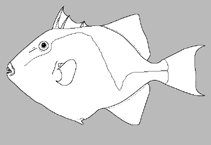
>
Tetraodontiformes (Puffers and filefishes) >
Balistidae (Triggerfishes)
Etymology: Canthidermis: Greek, kanthos = the outer or inner corner of the eye, where the lids meet, 1646 + Greek, derma = skin (Ref. 45335).
Eponymy: Francis Willughby (sometimes spelled Willoughby) (1635–1672) was a British ichthyologist and ornithologist, described as “…the first who with the practised eye of an ichthyologist examined the Charrs of England and Wales.” [...] (Ref. 128868), visit book page.
More on authors: Lay & Bennett.
Taxonomic Remarks
Status of nominal species remains uncertain (Ref. 124289:141).
Entorno: milieu / zona climática / rango de profundidad / gama de distribución
Ecología
marino asociado a arrecife. Tropical; - 12°S
Distribución
Territorios | Áreas FAO | Ecosistemas | Ocurrencias, apariciones | Mapa de puntos | Introducciones | Faunafri
Eastern Central Pacific.
Tamaño / Peso / Edad
Madurez: Lm ? range ? - ? cm
Max length : 13.1 cm SL macho / no sexado; (Ref. 44024)
Descripción breve
Claves de identificación | Morfología | Morfometría
Radios blandos anales: 21 - 22.
Body shape (shape guide): short and / or deep.
Ciclo vital y comportamiento de apareamiento
Madurez | Reproducción | Puesta | Huevos | Fecundidad | Larva
Matsunuma, M., S. Ikeguchi and Y. Kai, 2020. First specimen-based records of Canthidermis macrolepis (Tetraodontiformes: Balistidae) from the Pacific Ocean and comparisons with C. maculata. Species Diversity 25:135-144. (Ref. 124289)
Situación en la Lista Roja de la UICN (Ref. 130435: Version 2025-2 (Global))
Amenaza para el ser humano
Harmless
Usos humanos
Herramientas
Informes especiales
Descargar XML
Fuentes de Internet
Estimaciones basadas en modelos
Índice de diversidad filogenética (Referencia
82804): PD
50 = 0.5312 [Uniqueness, from 0.5 = low to 2.0 = high].
Bayesian length-weight: a=0.02754 (0.01326 - 0.05722), b=2.91 (2.74 - 3.08), in cm total length, based on LWR estimates for this (Sub)family-body shape (Ref.
93245).
Nivel trófico (Referencia
69278): 3.3 ±0.5 se; based on size and trophs of closest relatives
Resiliencia (Referencia
120179): Alto, población duplicada en un tiempo mínimo inferior a 15 meses (Preliminary K or Fecundity.).
Vulnerabilidad pesquera (Ref.
59153): Low vulnerability (10 of 100).
🛈