Klassifizierung / Names
Namen | Synonyme | Catalog of Fishes(Gattung, Arten) | ITIS | CoL | WoRMS | Cloffa
>
Gobiiformes (Gobies) >
Eleotridae (Bully sleepers)
Etymology: Mogurnda: Aboriginal name used in Australia.
Umwelt: Milieu / Klimazone / Tiefenbereich / Verbreitungsgebiet
Ökologie
; süßwasser benthopelagisch. Subtropical; 13°C - 41°C (Ref. 44894)
Oceania: central Australia.
Größe / Gewicht / Alter
Geschlechtsreife: Lm ? range ? - ? cm
Max length : 13.5 cm SL Männchen/unbestimmt; (Ref. 44894)
Kurzbeschreibung
Bestimmungsschlüssel | Morphologie | Morphometrie
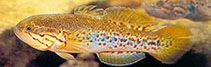
Rückenflossenstacheln (insgesamt) : 9 - 10; Rückenflossenweichstrahlen (insgesamt) : 10 - 12; Afterflossenstacheln: 1; Afterflossenweichstrahlen: 10 - 12. Color: three reddish diagonal stripes on head; body with many red spots overlying about 12 faint bluish bars (Ref. 44894).
Body shape (shape guide): fusiform / normal.
Inhabits artesian springs and associated swampy areas over a wide range of temperatures (13°-36°C). At one spring it was found in temperatures ranging from 21.6°-35.6°C, although it was most abundant in the cooler, downstream sections. Feeds on filamentous green algae, snails and fishes. Co-occurs with 5 other species at Dalhousie springs including Neosilurus gloveri (Plotosidae), Craterocephalus dalhousiensis and C. gloveri (Atherinidae), Leiopotherapon unicolor (Terapontidae) and Chlamydogobius gloveri (Gobiidae) (Ref. 44894).
Lebenszyklus und Paarungsverhalten
Geschlechtsreife | Fortpflanzung | Ablaichen | Eier | Fruchtbarkeit | Larven
Allen, G.R., S.H. Midgley and M. Allen, 2002. Field guide to the freshwater fishes of Australia. Western Australian Museum, Perth, Western Australia. 394 p. (Ref. 44894)
IUCN Rote Liste Status (Ref. 130435: Version 2025-2 (Global))
Bedrohung für Menschen
Harmless
Nutzung durch Menschen
Tools
Zusatzinformationen
Download XML
Internet Quellen
Schätzungen auf der Grundlage von Modellen
Phylogenetischer Diversitätsindex (Ref.
82804): PD
50 = 0.5000 [Uniqueness, from 0.5 = low to 2.0 = high].
Bayesian length-weight: a=0.00977 (0.00411 - 0.02324), b=3.08 (2.88 - 3.28), in cm total length, based on LWR estimates for this (Sub)family-body shape (Ref.
93245).
Trophische Ebene (Ref.
69278): 3.4 ±0.5 se; based on size and trophs of closest relatives
Widerstandsfähigkeit (Ref.
120179): mittel, Verdopplung der Population dauert 1,4 - 4,4 Jahre. (Preliminary K or Fecundity.).
Anfälligkeit der Fischerei (Ref.
59153): Low vulnerability (10 of 100).
🛈