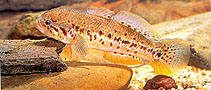
Klassifizierung / Names
Namen | Synonyme | Catalog of Fishes(Gattung, Arten) | ITIS | CoL | WoRMS | Cloffa
>
Gobiiformes (Gobies) >
Eleotridae (Bully sleepers)
Etymology: Mogurnda: Aboriginal name used in Australia.
Umwelt: Milieu / Klimazone / Tiefenbereich / Verbreitungsgebiet
Ökologie
; süßwasser benthopelagisch. Tropical
Oceania: Australia.
Größe / Gewicht / Alter
Geschlechtsreife: Lm ? range ? - ? cm
Max length : 13.0 cm SL Männchen/unbestimmt; (Ref. 44894)
Kurzbeschreibung
Bestimmungsschlüssel | Morphologie | Morphometrie
Rückenflossenstacheln (insgesamt) : 9 - 10; Rückenflossenweichstrahlen (insgesamt) : 9 - 12; Afterflossenstacheln: 1; Afterflossenweichstrahlen: 9 - 13.
Body shape (shape guide): fusiform / normal.
Found in rocky streams flowing through steep-sided valleys. May also be found on mud bottom lowland creeks if the specimen from the Bulloo River, Queensland is identified to be this species. Spawning occurs at temperatures over 20°C. Females lay between 200 and 800 eggs, usually on the underside of a hard object. The male guards the eggs until hatching, which takes about 7 days. Fry are approximately 5 millimeters long and there is no parental care after hatching. A poorly known species (Ref. 44894).
Females lay eggs on underside of hard object; male guard eggs until hatching; fry about 5 mm long at birth; no parental care after hatching (Ref. 44894).
Allen, G.R., S.H. Midgley and M. Allen, 2002. Field guide to the freshwater fishes of Australia. Western Australian Museum, Perth, Western Australia. 394 p. (Ref. 44894)
IUCN Rote Liste Status (Ref. 130435: Version 2025-2 (Global))
Bedrohung für Menschen
Harmless
Nutzung durch Menschen
Tools
Zusatzinformationen
Download XML
Internet Quellen
Schätzungen auf der Grundlage von Modellen
Phylogenetischer Diversitätsindex (Ref.
82804): PD
50 = 0.5000 [Uniqueness, from 0.5 = low to 2.0 = high].
Bayesian length-weight: a=0.00977 (0.00411 - 0.02324), b=3.08 (2.88 - 3.28), in cm total length, based on LWR estimates for this (Sub)family-body shape (Ref.
93245).
Trophische Ebene (Ref.
69278): 3.4 ±0.5 se; based on size and trophs of closest relatives
Widerstandsfähigkeit (Ref.
120179): mittel, Verdopplung der Population dauert 1,4 - 4,4 Jahre. (Fec=200).
Anfälligkeit der Fischerei (Ref.
59153): Low vulnerability (10 of 100).
🛈