>
Gobiiformes (Gobies) >
Gobiidae (Gobies) > Gobiinae
Etymology: Asterropteryx: Greek, a = with + Greek, sterros, -a, -on = consistent + Greek, pteryx = fin (Ref. 45335); atripes: Named for its conspicuouc black pelvic fin.
Ambiente: milieu / zona climatica / distribuzione batimetrica / gamma di distribuzione
Ecologia
marino associati a barriera corallina; distribuzione batimetrica 10 - 25 m (Ref. 90102). Subtropical
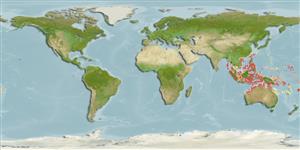
Indo-West Pacific: Andaman Is., Brunei, Ryukyu Islands, the Philippines and Indonesia.
Dimensione / Peso / Età
Maturità: Lm ? range ? - ? cm
Max length : 2.2 cm SL maschio/sesso non determinato; (Ref. 44260)
Breve descrizione
Chiavi di identificazione | Morfologia | Morfometria
Spine dorsali (totale) : 6 - 7; Raggi dorsali molli (totale) : 9 - 10; Spine anali: 1; Raggi anali molli: 9; Vertebre: 26. This species is distinguished from its congeners by having the following combination
of characters: long, filamentous 3rd spine of 1st dorsal fin, distal tip usually over end of 2nd dorsal fin base when adpressed; almost separated pelvic fins, innermost (= 5th) segmented rays connected by rudimentary low membrane between bases, no frenum; 4-7 short spines on posterior margin of preopercle (uppermost spine usually just behind the cephalic sensory canal pore N); large eye, 32.3-35.8% of head length; enlarged haemal arches on 1st two caudal vertebrae; posterior margin of eye to caudal fin base has a distinct black band (indistinct in dark-phase individuals); black pelvic fin (vivid in dark phase individuals); many minute bright blue spots on head and body when live or fresh; distinct dark spots on head and body absent; iris entirely reddish-brown or dusky (bright white ventrally in pale-phase individuals) when alive or fresh, becoming entirely black in preservation, with no white transverse bar on middorsal surface; has a hovering habit (Ref. 44260).
Body shape (shape guide): elongated; Cross section: compressed.
Inhabits sheltered bays on sand, rubble and mud bottoms in 10-25 m (Ref 90102).
Ciclo vitale e comportamento di accoppiamento
Maturità | Riproduzione | Deposizione | Uova | Fecondità | Larve
Shibukawa, K. and T. Suzuki, 2002. Asterropteryx atripes, a new gobiid fish from the Western Pacific Ocean (Perciformes: Gobioidei). Ichthyol. Res. 49(3):274-280. (Ref. 44260)
Stato della Lista Rossa IUCN (Ref. 130435: Version 2025-2 (Global))
Minaccia per l'uomo
Harmless
Usi umani
Strumenti
Rapporti speciali
Scarica XML
Fonti Internet
Stime basate su modelli
Temperatura preferita (Fonte Biblio.
123201): 26.7 - 29.3, mean 28.7 °C (based on 1945 cells).
Indice di diversità filogenetica (Fonte Biblio.
82804): PD
50 = 0.5020 [Uniqueness, from 0.5 = low to 2.0 = high].
Bayesian length-weight: a=0.00741 (0.00347 - 0.01582), b=3.09 (2.91 - 3.27), in cm total length, based on LWR estimates for this (Sub)family-body shape (Ref.
93245).
Livello trofico (Fonte Biblio.
69278): 3.2 ±0.4 se; based on size and trophs of closest relatives
Resilienza (Fonte Biblio.
120179): Alto, tempo minimo di raddoppiamento della popolazione meno di 15 mesi (Preliminary K or Fecundity.).
Vulnerabilità della pesca (Ref.
59153): Low vulnerability (10 of 100).
🛈
Nutrienti (Ref.
124155): Calcium = 320 [117, 1,108] mg/100g; Iron = 1.95 [0.71, 4.97] mg/100g; Protein = 18.1 [15.9, 20.1] %; Omega3 = 0.158 [0.045, 0.524] g/100g; Selenium = 15.8 [3.8, 55.1] μg/100g; VitaminA = 103 [17, 601] μg/100g; Zinc = 3.01 [1.41, 5.56] mg/100g (wet weight);