>
Mulliformes (Goatfishes) >
Mullidae (Goatfishes)
Etymology: Mulloidichthys: Latin, mullus = soft + Greek, ichthys = fish (Ref. 45335).
More on author: Lacepède.
Taxonomic Remarks
The subspecies Mulloidichthys flaviolineatus flavicaudus Fernandez-Silva & Randall, 2016 remains in the synonymy of Mulloidichthys flavolineatus; the two subspecies can be at best understood as two well-differentiated populations, in Uiblein et al., 2020 (Ref. 123209:148).
Environnement : milieu / zone climatique / profondeur / gamme de distribution
Écologie
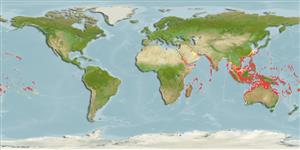
marin récifal; profondeur 1 - 99 m (Ref. 123209). Tropical; 30°N - 37°S, 22°E - 124°W
Indo-Pacific: Red Sea, East and South Africa, Madagascar and Mascarenes to the Hawaiian Is., Line Is. and Pitcairn Group; north to southern Japan and Midway Is.; south to Australia (North West Cape, WA, Eastern Australia, NSW) at 36°S, Lord Howe I. and New Caledonia; one record from New Zealand. Common throughout most of its range (Ref. 9710).
Longueur à la première maturité / Taille / Poids / Âge
Maturité: Lm 20.8, range 12 - ? cm
Max length : 43.0 cm TL mâle / non sexé; (Ref. 9710); common length : 25.0 cm TL mâle / non sexé; (Ref. 30573); poids max. publié: 423.30 g (Ref. 121845)
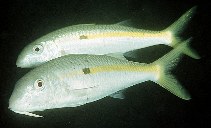
Épines dorsales (Total) : 8; Rayons mous dorsaux (Total) : 9; Épines anales: 1; Rayons mous anaux: 7. Back grey to olive, sides and belly whitish; 1-2 longitudinal yellow bands; dark blotch below 1st dorsal fin (Ref. 5405). Yellow-mid-lateral stripe from eye to tail and some yellow striping on cheek and along abdomen (Ref. 48636). Head length 3.1-3.5 in SL, length of snout 1.9.-2.2 and barbel 1.4-1.7 in HL. Body depth 3.7-4.8 in SL. (Ref. 90102)
Body shape (shape guide): fusiform / normal; Cross section: oval.
Occasionally schooling species inhabit shallow sandy areas of lagoon and seaward reefs (Ref. 9710). Large adults are often found solitary on sand slopes with other species following to feed on prey that are disturbed when the goatfish is feeding (Ref. 48636). Benthopelagic (Ref. 58302). Feed on crustaceans, mollusks, worms, heart urchins and foraminiferans. Consumed fresh or dried. Minimum depth reported taken from Ref. 30874.
Myers, R.F., 1991. Micronesian reef fishes. Second Ed. Coral Graphics, Barrigada, Guam. 298 p. (Ref. 1602)
Statut dans la liste rouge de l'IUCN (Ref. 130435: Version 2025-2 (Global))
Menace pour l'homme
Reports of ciguatera poisoning (Ref. 130160)
Utilisations par l'homme
Pêcheries: commercial; pêche sportive: oui; Aquarium: Commercial; appât: usually
Outils
Articles particuliers
Télécharger en XML
Sources Internet
Estimations basées sur des modèles
Température préférée (Réf.
123201): 24.5 - 29, mean 27.8 °C (based on 1256 cells).
Indice de diversité phylogénétique (Réf.
82804): PD
50 = 0.5078 [Uniqueness, from 0.5 = low to 2.0 = high].
Bayesian length-weight: a=0.01047 (0.00914 - 0.01199), b=3.09 (3.05 - 3.13), in cm total length, based on LWR estimates for this species (Ref.
93245).
Niveau trophique (Réf.
69278): 3.8 ±0.3 se; based on diet studies.
Résilience (Réf.
120179): Milieu, temps minimum de doublement de population : 1,4 à 4,4 années (K=0.16-0.9;).
Prior r = 0.57, 95% CL = 0.37 - 0.85, Based on 2 data-limited stock assessments.
Vulnérabilité de la pêche (Ref.
59153): Moderate vulnerability (39 of 100).
🛈
Vulnérabilité climatique (Ref.
125649): Moderate to high vulnerability (46 of 100).
🛈
Nutriments (Ref.
124155): Calcium = 41.7 [22.8, 67.6] mg/100g; Iron = 0.474 [0.224, 0.798] mg/100g; Protein = 18.8 [17.0, 20.5] %; Omega3 = 0.159 [0.108, 0.280] g/100g; Selenium = 34.4 [21.0, 57.4] μg/100g; VitaminA = 91.6 [32.7, 311.0] μg/100g; Zinc = 1.01 [0.64, 1.39] mg/100g (wet weight);