分類 / 名前
共通名の | 類義語 | Catalog of Fishes(部類, 種) | ITIS | CoL | WoRMS | Cloffa
板鰓亜鋼(サメとエイ類) (sharks and rays) >
Rajiformes (Skates and rays) >
Rajidae (Skates)
Etymology: Dipturus: Greek, di = two + Greek, pteryx = fin (Ref. 45335); mennii: Named for Roberto Carlos Menni.
Eponymy: Dr Roberto Carlos Menni is an ichthyologist and professor at Museo de La Plata, Universidad Nacional de La Plata, Argentina. [...] (Ref. 128868), visit book page.
環境:環境 / 気候帯 / 深さの範囲 / 分布範囲
生態学
海 底生の; 深さの範囲 135 - 550 m (Ref. 114953). Subtropical; 20°S - 40°S, 60°W - 40°W (Ref. 57911)
Southwest Atlantic: Brazil, from São Paulo to Rio Grande do Sul.
初回成熟時の長さ / サイズ / 重さ / 年齢
成熟: Lm ?, range 62 - ? cm
Max length : 167 cm TL オス/雌雄の選別がない; (Ref. 114953)
簡単な記述
検索表 | 形態学 | 形態計測学
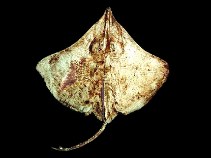
Differs from its congeners by having prickly interorbital space with few developed dermal denticles an no arrangement pattern easily visible and sensible when touched. Dorsal surface smooth with nuchal thorns confluent with median dorsal and caudal thorns up to the origin of the first dorsal fin. Scapular and interdorsal thorns are present. Ventral surface with rare, few developed prickles in between the gill openings. Mature specimens reaching about 160 cm TL and 120 cm disk width. Dorsal and ventral surfaces brown, with ventral tip of pectoral fins light brown. Dorsal and ventral snout surfaces prickly with several tiny prickles. Anterior margin of pectoral fins convex in males. Orbital series thorns distributed as 4 preorbital and 2 to 3 interorbital; the postorbital thorns are absent. The rest of thorns are distributed as 2 to 5 interspiracular; 5 to 6 nuchal, 2 to 3 scapular and 12 to 18 mediodorsal. The caudal region bears 3 to 5 rows of thorns; 25 to 36 mediocaudal; 7 to 24 laterocaudal on the left and on the right; 43 to 47 alar thorns present in males, in 3 rows and 1 to 3 interdorsal; 12-16 pseudobranchial lamellae. The horizontal orbit diameter 2 times length of second dorsal fin base. The length of first dorsal fin base is equal to the interorbital distance. The dorsal region of claspers is smooth. The dental formula is 33-36/30-37.
This species is similar with Dipturus trachyderma in having the rough skin on the interorbital region; both differ from D. leptocauda, D. chilensis, and D. teevani which possess smooth interorbital region. Other body regions of D. mennii have less evident dermal denticles, but sensible when touched, and because of this, this species was mistaken for D. trachyderma.
D. mennii compared with D. trachyderma, exhibits 1 row of confluent thorns from nape to first dorsal fin origin while the latter exhibits a row of thorns in caudal region only; have 4 preorbital thorns (vs. 2); 2-3 interorbital and no postorbital thorns (vs. 1 interorbital and 1 postorbital thorn); mature males with 3 rows of alar thorns with variation of the total number 43-47 (vs. 4 rows with total 17- 48); dorsal region of claspers smooth (vs. rough); proportionally smaller in disc width and length, horizontal orbit diameter, distance between first and fifth gill openings and dorsal fins base.
D. mennii differs from other Brazilian species (leptocauda and chilensis) in spinulation arrangement; with the two exhibiting smooth dorsal region with 1 nuchal thorn and no mediodorsal and laterocaudal thorns (Ref. 42991).
Body shape (shape guide): other.
Inhabit continental slopes. Oviparous (Ref. 50449). Eggs have horn-like projections on the shell (Ref. 205). Maturity size unknown, 95 cm TL male was still immature (Ref. 114953).
ライフサイクルと交尾行動
成熟 | 繁殖 | 放精 | 卵 | 生産力 | 幼生
Oviparous, paired eggs are laid. Embryos feed solely on yolk (Ref. 50449). Eggs have horn-like projections on the shell (Ref. 205).
Gomes, U.L. and C. Paragó, 2001. Espécie nova de rajídeo (Chondrichthyes, Rajiformes) do Atlântico Sul Ocidental. Bol. Do Mus. Nac., N.S., Zool., Rio de Janeiro 448:1-10. (Ref. 42991)
IUCNのレッドリストの状況は (Ref. 130435: Version 2025-2 (Global))
人間の用途
用具
特記事項
XMLをダウンロードして下さい
インターネットの情報源
モデルに基づく推定値
系統多様性指数 (参照
82804): PD
50 = 0.5000 [Uniqueness, from 0.5 = low to 2.0 = high].
Bayesian length-weight: a=0.00288 (0.00136 - 0.00613), b=3.25 (3.08 - 3.42), in cm total length, based on LWR estimates for this Genus-body shape (Ref.
93245).
栄養段階 (参照
69278): 4.0 ±0.6 se; based on size and trophs of closest relatives
回復力 (参照
120179): 低い, 4.5年~14年の倍増期間の最小個体群 (Fec assumed to be <100).
漁業の脆弱性 (Ref.
59153): Very high vulnerability (90 of 100).
🛈