>
Cichliformes (Cichlids, convict blennies) >
Cichlidae (Cichlids) > Pseudocrenilabrinae
Etymology: Rubricatochromis: Name from rubricatus, Latin for red coloured, refers to the bright red colouration on body of most species when in dominance or broodcare; and chromis, a common ending for African cichlid fishes (Ref. 128620).
Environnement : milieu / zone climatique / profondeur / gamme de distribution
Écologie
; eau douce benthopélagique. Tropical; 22°C - 26°C (Ref. 2059)
Africa: Equatorial Guinea to Cabinda, including central regions of Gabon (Ref. 81260). Also in western Republic of Congo (Ref. 81260) and in the Congo River from Pool Malebo (=Stanley Pool) to its estuary (Ref. 43352). Also present in the Likouala and Likouala-aux-Herbes, upstream from Pool Malebo in the middle Congo River basin, in Republic of Congo (Ref. 43352).
Taille / Poids / Âge
Maturité: Lm ? range ? - ? cm
Max length : 10.0 cm SL mâle / non sexé; (Ref. 5644)
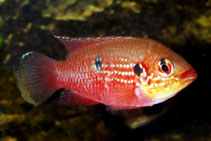
Épines dorsales (Total) : 13 - 15; Rayons mous dorsaux (Total) : 10 - 12; Épines anales: 3; Rayons mous anaux: 7 - 9. Diagnosis: never with multiple series of distinct blotches or bars on flanks; iridophores often visible on head, but rarely present on body or unpaired fins; mid-lateral black spot always present, rounded and relatively large, sometimes bordered by a light zone around posterior and anterior edges (but not fully ocellated); sometimes small black spots and/or 7-9 narrow black bars on dorsum, sometimes reaching to mid-body; black spot on caudal peduncle normally absent, or if present, small and ovoid (Ref. 81260).
Body shape (shape guide): fusiform / normal.
Pair-bonding, substrate brooder (Ref. 52307, 81260).
Cycle de vie et comportement reproducteur
Maturité | Reproduction | Frai | Œufs | Fécondité | Larves
Lamboj, A. and S. Koblmüller, 2022. Molecular phylogeny and taxonomic revision of the cichlid genus Hemichromis (Teleostei, Cichliformes, Cichlidae), with description of a new genus and revalidation of H. angolensis. Hydrobiologia (2022):1-22. (Ref. 128620)
Statut dans la liste rouge de l'IUCN (Ref. 130435: Version 2025-2 (Global))
Menace pour l'homme
Harmless
Utilisations par l'homme
Outils
Articles particuliers
Télécharger en XML
Sources Internet
Estimations basées sur des modèles
Indice de diversité phylogénétique (Réf.
82804): PD
50 = 0.5020 [Uniqueness, from 0.5 = low to 2.0 = high].
Bayesian length-weight: a=0.01445 (0.00671 - 0.03113), b=2.99 (2.82 - 3.16), in cm total length, based on LWR estimates for this (Sub)family-body shape (Ref.
93245).
Niveau trophique (Réf.
69278): 3.4 ±0.5 se; based on size and trophs of closest relatives
Résilience (Réf.
120179): Haut, temps minimum de doublement de population inférieur à 15 mois (Preliminary K or Fecundity.).
Vulnérabilité de la pêche (Ref.
59153): Low vulnerability (10 of 100).
🛈