>
Cyprinodontiformes (Rivulines, killifishes and live bearers) >
Poeciliidae (Poeciliids) > Poeciliinae
Etymology: Xiphophorus: Greek, xiphos = sword + Greek, pherein = to carry (Ref. 45335).
Eponymy: Named after the Mayan people who inhabit the areas of Central America where these fish occur. [...] (Ref. 128868), visit book page.
Environnement : milieu / zone climatique / profondeur / gamme de distribution
Écologie
; eau douce benthopélagique. Tropical; ? - 26°C (Ref. 42936)
Central America: Guatemala and Honduras.
Taille / Poids / Âge
Maturité: Lm ? range ? - ? cm
Max length : 7.8 cm SL mâle / non sexé; (Ref. 50894)
Description synthétique
Clés d'identification | Morphologie | Morphométrie
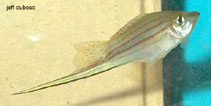
Épines dorsales (Total) : 0; Rayons mous dorsaux (Total) : 14; Épines anales: 0; Rayons mous anaux: 9; Vertèbres: 28 - 29. Distal part of gonopodium blade ray 3 bluntly pointed; three quarters of the caudal fin with fine red stripes; claw of tip of gonopodium ray 5 greatly enlarged; height/length ratios of tip of blade 5.6-6.3; dark pigmentation of the midlateral band continuous with the dark dorsal pigmentation of the sword in male. Caudal fin in males ray 5-8 forming a long sword; pelvic fin in females reaching to anal-fin base, in males to middle of gonopodium, second ray extremely prolonged and split, middle region thickened (Ref. 42936).
Body shape (shape guide): fusiform / normal.
Collected in an area where the water is gray and substratum consists predominantly of large black boulders, gravel and mud; aquatic vegetation mainly with reeds and Vallisneria (Ref. 42936).
Cycle de vie et comportement reproducteur
Maturité | Reproduction | Frai | Œufs | Fécondité | Larves
Meyer, M.K. and M. Schartl, 2002. Xiphophorus mayae, a new species of swordtail from Guatemala (Teleostei: Poeciliidae). Ichthyol. Explor. Freshwat. 13(1):59-66. (Ref. 42936)
Statut dans la liste rouge de l'IUCN (Ref. 130435: Version 2025-2 (Global))
Menace pour l'homme
Harmless
Utilisations par l'homme
Outils
Articles particuliers
Télécharger en XML
Sources Internet
Estimations basées sur des modèles
Indice de diversité phylogénétique (Réf.
82804): PD
50 = 0.5000 [Uniqueness, from 0.5 = low to 2.0 = high].
Bayesian length-weight: a=0.01047 (0.00458 - 0.02392), b=3.14 (2.96 - 3.32), in cm total length, based on LWR estimates for this (Sub)family-body shape (Ref.
93245).
Niveau trophique (Réf.
69278): 3.1 ±0.4 se; based on size and trophs of closest relatives
Résilience (Réf.
120179): Milieu, temps minimum de doublement de population : 1,4 à 4,4 années (Preliminary K or Fecundity.).
Vulnérabilité de la pêche (Ref.
59153): Low vulnerability (10 of 100).
🛈