>
Syngnathiformes (Pipefishes and seahorses) >
Syngnathidae (Pipefishes and seahorses) > Nerophinae
Etymology: Doryrhamphus: Greek, dory = lance + Greek, rhamphos = bill, beak (Ref. 45335).
More on author: Kaup.
Môi trường: môi trường / vùng khí hậu / Mức độ sâu / phạm vi phân phối
Sinh thái học
biển cùng sống ở rạn san hô; không di cư (Ref. 52884); mức độ sâu 2 - 50 m (Ref. 30874). Tropical; 30°N - 32°S
Indo-Pacific and Eastern Pacific: Persian Gulf and East Africa to the west coast of the Americas. It was noted by Dawson (Ref. 5316) that there is a clinal increase in the number of total rings and dorsal rays for the 3 subspecies (Red Sea, D. e. abbreviatus and Eastern Pacific D. e. paulus (Ref. 86689).
Bộ gần gũi / Khối lượng (Trọng lượng) / Tuổi
Chín muồi sinh dục: Lm ? range ? - ? cm
Max length : 7.0 cm TL con đực/không giới tính; (Ref. 9710)
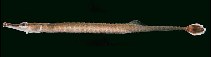
Các tia vây lưng cứng (tổng cộng) : 0; Các vây lưng mềm (tổng cộng) : 21 - 29; Tia cứng vây hậu môn: 0; Tia mềm vây hậu môn: 4. Superior trunk and tail ridges discontinuous; inferior trunk ridge ending on anal ring; lateral trunk ridge continuous with inferior tail ridge; body rings 17-19; tail rings 13-17. Also Ref. 4281.
Body shape (shape guide): eel-like; Cross section: angular.
Uncommon, cryptic species (Ref. 5227), prefers crevices in rocks and corals and areas beneath ledges (Ref. 28023). Occurs in lagoon and seaward reefs to a depth of 45 m or more (Ref. 9710). Benthopelagic (Ref. 58302). Often seen in pairs. Uses its tubelike snout to ingest small crustaceans and plankton (Ref. 28023). Ovoviviparous (Ref. 205). The male carries the eggs in a brood pouch which is found under the tail (Ref. 205). Monogamous and always in home-ranging pairs, that is they do not defend an exclusive territory (Ref. 52884).
Vòng đời và hành vi giao phối
Chín muồi sinh dục | Sự tái sinh sản | Đẻ trứng | Các trứng | Sự sinh sản | Ấu trùng
Monogamous mating is observed as both obligate and genetic (Ref. 52884). Male carries the eggs in a brood pouch (Ref. 205).
Stiller, J., G. Short, H. Hamilton, N. Saarman, S. Longo, P. Wainwright, G.W. Rouse and W.B. Simison, 2022. Phylogenomic analysis of Syngnathidae reveals novel relationships, origins of endemic diversity and variable diversification rates. BMC Biology 20 (art. 75):1-22. [New family-group names in Additional file 1.] (Ref. 127687)
Tình trạng Sách đỏ IUCN (Ref. 130435: Version 2025-2 (Global))
Mối đe dọa đối với con người
Harmless
Sử dụng của con người
Các nghề cá: tính thương mại; Bể nuôi cá: Tính thương mại
Các công cụ
Báo cáo đặc biệt
Tải xuống XML
Các nguồn internet
Ước tính dựa trên mô hình
Nhiệt độ ưa thích (Tài liệu tham khảo
123201): 24.7 - 29, mean 27.7 °C (based on 800 cells).
Chỉ số đa dạng phát sinh loài (Tài liệu tham khảo
82804): PD
50 = 0.5010 [Uniqueness, from 0.5 = low to 2.0 = high].
Bayesian length-weight: a=0.00123 (0.00063 - 0.00239), b=3.09 (2.91 - 3.27), in cm total length, based on LWR estimates for this species & (Sub)family-body (Ref.
93245).
Mức dinh dưỡng (Tài liệu tham khảo
69278): 3.5 ±0.44 se; based on food items.
Thích nghi nhanh (Tài liệu tham khảo
120179): Chiêù cao, thời gian nhân đôi của chủng quần tối thiểu là dưới 15 tháng (Preliminary K or Fecundity.).
Sự dễ bị tổn thương của nghề đánh cá (Ref.
59153): Low vulnerability (10 of 100).
🛈
Chất dinh dưỡng (Ref.
124155): Calcium = 185 [102, 389] mg/100g; Iron = 1.21 [0.67, 2.13] mg/100g; Protein = 17.4 [16.2, 18.7] %; Omega3 = 0.13 [0.07, 0.26] g/100g; Selenium = 32.9 [15.0, 83.3] μg/100g; VitaminA = 173 [55, 534] μg/100g; Zinc = 2.25 [1.44, 3.27] mg/100g (wet weight);