>
Eupercaria/misc (Various families in series Eupercaria) >
Labridae (Wrasses) > Xyrichtyinae
Etymology: Ammolabrus: Greek, ammos = sand + see Labrus; dicrus: From the Greek dikros, forked, in reference to the forked caudal fin.
More on authors: Randall & Carlson.
Umwelt: Milieu / Klimazone / Tiefenbereich / Verbreitungsgebiet
Ökologie
seewasser benthopelagisch; tiefenbereich 7 - 18 m (Ref. 26794). Tropical
Verbreitung
Territorien | FAO Gebiete | Ökosysteme | Vorkommen | Punkt Karte | Einführungen | Faunafri
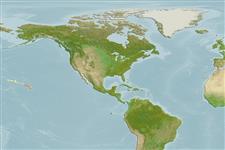
Eastern Central Pacific: known only from O'ahu, Hawaiian Islands.
Größe / Gewicht / Alter
Geschlechtsreife: Lm ? range ? - ? cm
Max length : 9.4 cm SL Männchen/unbestimmt; (Ref. 26794)
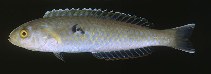
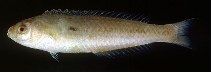
Rückenflossenstacheln (insgesamt) : 9; Rückenflossenweichstrahlen (insgesamt) : 12; Afterflossenstacheln: 3; Afterflossenweichstrahlen: 12; Wirbelzahl: 25. Flexible anal fin spines; 19 or 20 + 5 or 6 pored lateral line scales with single horizontal tubule, ending in a pore; scales thin and rhomboidal, those of thorax and anterior abdomen smaller than those of side of body; head naked except for 2 small scales dorsally on opercle and diagonal row of 5 partially embedded scales behind eye; no median predorsal scales; 3 small median prepelvic scales; anterior third of prepelvic region naked; branchiostegal rays 6; upper jaw strongly protrusible, median process of premaxilla extending to above anterior pupil edge; body moderately elongate, the depth 4.2-4.45 in SL; dorsal part of head from front of snout to origin of dorsal fin with a fleshy median ridge, the interorbital space high and triangular when viewed from the front; interorbital space narrowest anteriorly; caudal fin small, 1.45-1.65 in head length; pelvic fins small, 2.2-3.05 in head length (Ref. 26794).
Body shape (shape guide): elongated.
Adults are found over open sand bottom, in small, swift-swimming schools (Ref. 26794). Feed on zooplankton above the substratum (Ref. 26794, 58466). Oviparous, distinct pairing during breeding (Ref. 205).
Lebenszyklus und Paarungsverhalten
Geschlechtsreife | Fortpflanzung | Ablaichen | Eier | Fruchtbarkeit | Larven
Oviparous, distinct pairing during breeding (Ref. 205).
Parenti, P. and J.E. Randall, 2000. An annotated checklist of the species of the labroid fish families Labridae and Scaridae. Ichthyol. Bull. J.L.B. Smith Inst. Ichthyol. (68):1-97. (Ref. 35918)
IUCN Rote Liste Status (Ref. 130435: Version 2025-2 (Global))
Bedrohung für Menschen
Harmless
Nutzung durch Menschen
Tools
Zusatzinformationen
Download XML
Internet Quellen
Schätzungen auf der Grundlage von Modellen
Phylogenetischer Diversitätsindex (Ref.
82804): PD
50 = 1.0000 [Uniqueness, from 0.5 = low to 2.0 = high].
Bayesian length-weight: a=0.00661 (0.00272 - 0.01607), b=3.05 (2.84 - 3.26), in cm total length, based on LWR estimates for this (Sub)family-body shape (Ref.
93245).
Trophische Ebene (Ref.
69278): 3.3 ±0.5 se; based on size and trophs of closest relatives
Widerstandsfähigkeit (Ref.
120179): hoch, Verdopplung der Population dauert weniger als 15 Monate. (Preliminary K or Fecundity.).
Anfälligkeit der Fischerei (Ref.
59153): Low vulnerability (10 of 100).
🛈